
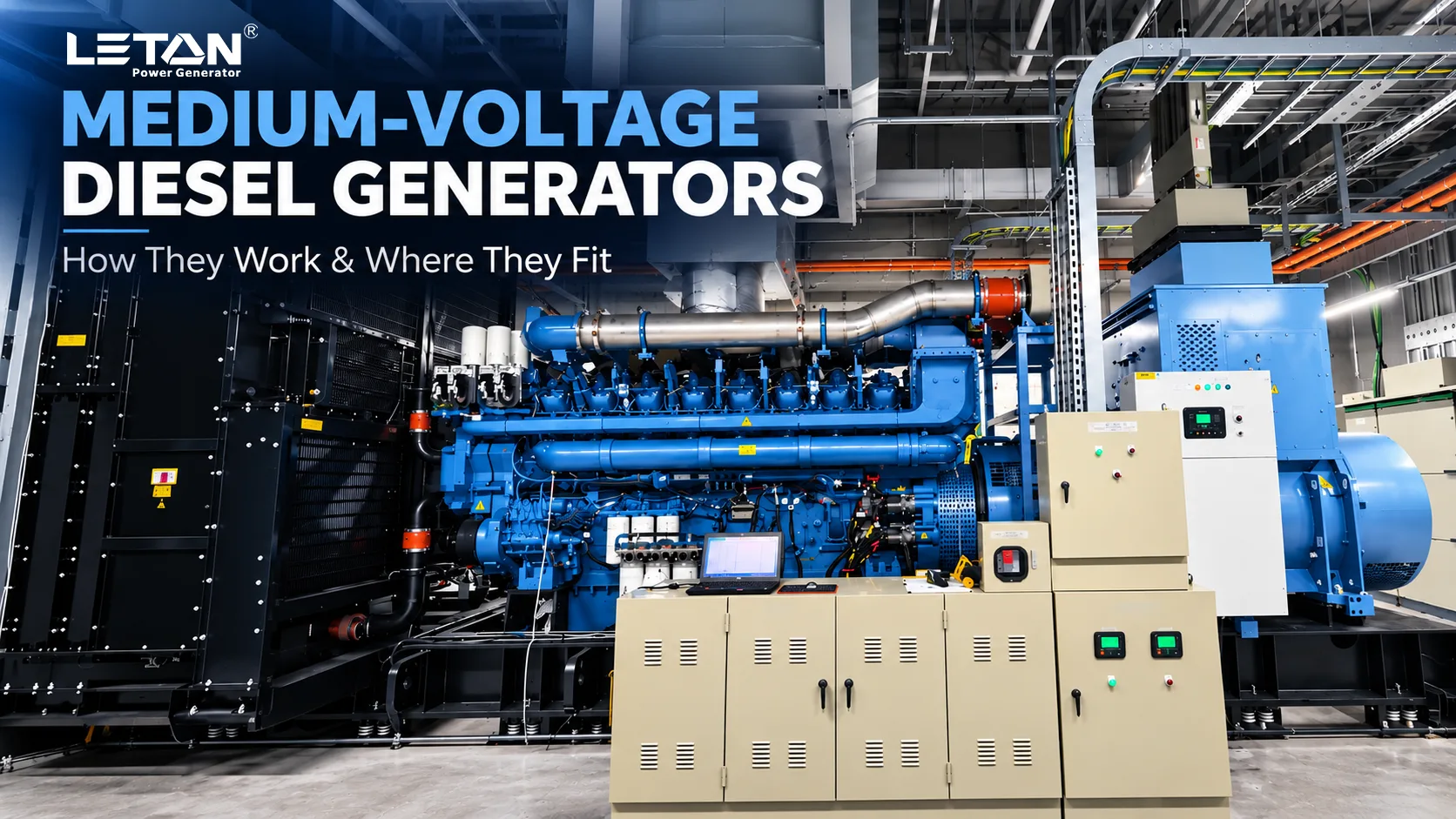
The equipment, distribution benefits, and operating requirements behind large generator systems
At several megawatts, the voltage of a generator system can have a significant effect on how power moves across a facility.
Low-voltage generation may require high currents and numerous parallel cable runs. For a large campus or industrial site, generating at medium voltage can reduce feeder current and provide a practical way to distribute power over longer distances.
The choice depends on the whole installation. Distribution distances, the existing network, switchgear, transformers, protection, and maintenance requirements all belong in the comparison.
What medium voltage means in this context
Chinese technical writing often describes generator sets above 1 kV as “high-voltage generators.” The several-kilovolt systems discussed here are commonly called medium-voltage, or MV, systems in international power-distribution practice. Definitions vary by region and standard, so the actual operating voltage should always be stated. Schneider Electric: Medium-Voltage Switchgear
Examples include 6 kV and 10 kV generation, compared with conventional 380 or 400 V systems. Other voltage options are available for particular markets and equipment. Choose a voltage that fits the site’s distribution system and the selected generator configuration.
Output voltage is separate from rated power. It also does not establish the engine’s permitted duty, transient response, or service life.
How the system produces and controls power
The generating principle is the same at low and medium voltage. A diesel engine drives the alternator’s rotor. Electromagnetic induction converts the mechanical rotation into electrical power.
The engine and alternator work with several supporting systems. Fuel supply, starting equipment, cooling, ventilation, and exhaust must suit the operating duty and site conditions. The alternator’s windings, insulation system, and terminals must be designed for the specified voltage.
Switchgear connects the generator output to the distribution network. Circuit breakers switch and interrupt power, instrument transformers provide measurements, and protective relays detect faults and initiate the required response. Protection settings and the grounding arrangement must be coordinated with the complete network.
On a plant with several generators, the controls synchronize the machines before their breakers close and manage load sharing afterward. The approved operating sequence determines how units start, join the bus, respond to changing demand, and disconnect following a fault.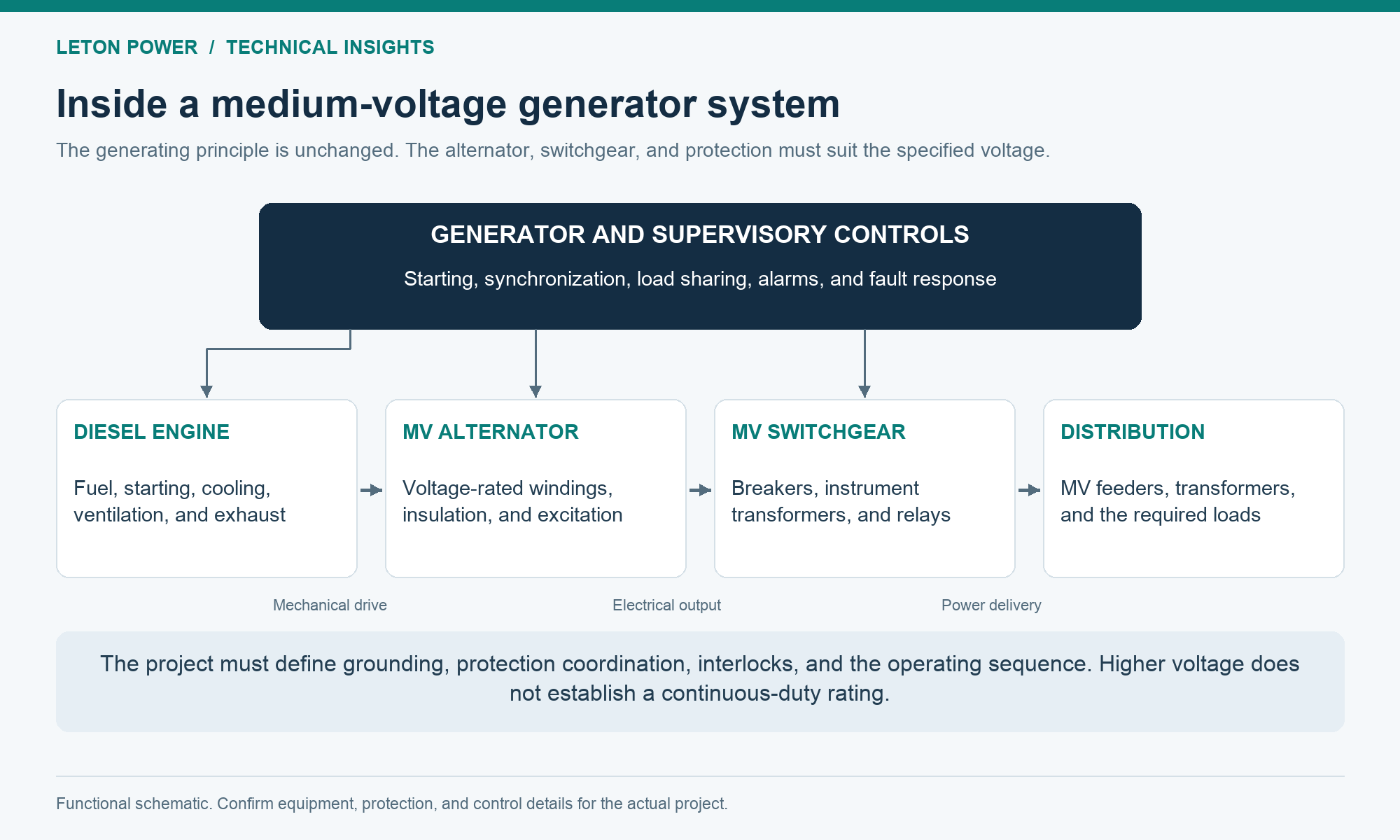
Figure 1. A simplified view of the engine, alternator, switchgear, distribution, and controls. A project design must define the actual protection, grounding, and operating sequence.
Equipment must withstand the electrical stresses associated with its rated voltage. The insulation’s thermal class describes its temperature capability, a separate property. Both need to be confirmed in the specification.
Why higher voltage reduces current
For a balanced three-phase system:
P = √3 × V × I × PF
P is real power, V is line-to-line voltage, I is line current, and PF is power factor. For the same power and power factor, a higher voltage means a lower current.
For an illustrative 2 MW load at a power factor of 0.8:

The 10 kV feeder carries the same power at one twenty-fifth of the current. This calculation compares electrical conditions; it does not select a cable size or account for transformer losses.、
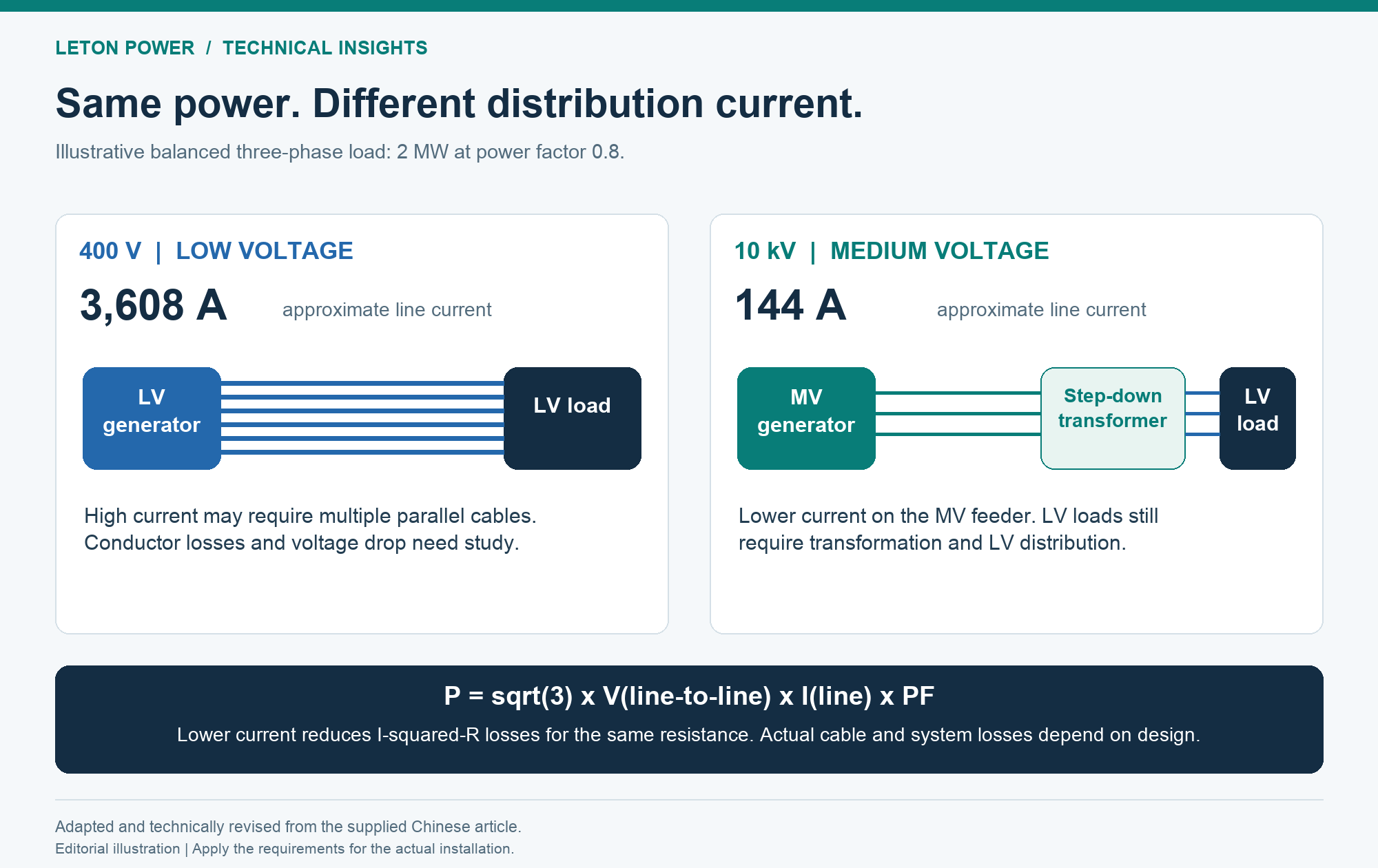
Figure 2. Lower current on an MV feeder can ease distribution requirements. Low-voltage loads still need appropriate transformation and downstream distribution. Cable counts are illustrative.
Resistive conductor losses are proportional to I²R. Lower current reduces those losses for the same resistance. In an actual design, resistance depends on the cables selected, while transformers and other equipment introduce additional losses. Calculate the complete system before stating the expected saving.
Where medium-voltage generation can help
Cummins’ application guidance identifies high current at low voltage and significant distribution distances as reasons to consider MV generation. These are useful starting points for comparing system layouts. Cummins application manual, Section 5.2.5
Large data centers may use MV distribution to serve multiple buildings or load blocks. The generator plant must be integrated with transformers, UPS systems, transfer arrangements, and the required redundancy. Its voltage alone does not establish the facility’s resilience classification.
Industrial plants and mining sites may already have an MV network or large motor loads. Matching generation to that network can be practical, provided the design accounts for motor starting, load changes, fault levels, and grounding.
Airports, rail facilities, and major commercial developments can also have widely distributed critical loads. Feeder routes and restoration requirements help determine whether an MV arrangement is appropriate.
A generator may support power-station auxiliaries during a planned black-start sequence. That capability needs to be designed and verified for the installation; it does not follow automatically from MV output.
Evaluate the installation and the operating team
Lower feeder current can reduce the need for extensive parallel low-voltage conductors. An MV bus can also provide a useful basis for a larger generator plant.
These advantages must be weighed against the cost and space required for MV switchgear, cable terminations, transformers, protection, and maintenance access. Savings in cable installation do not guarantee a lower total project cost or a smaller equipment room.
Safety and maintenance require qualified personnel, appropriate interlocks, and defined isolation and grounding procedures. Protective relays detect and isolate specified faults; they cannot eliminate every failure or guarantee uninterrupted supply.
The operating rating remains important too. Standby, prime, and continuous ratings describe different duties. A higher output voltage does not permit a standby-rated set to run indefinitely at its advertised standby power. Confirm the selected rating, site derating, fuel arrangements, and maintenance requirements.
When evaluating an MV solution with LETON POWER, begin with the required net power, load behavior, distribution distances, and reliability objectives. Include the operating team’s ability to maintain and test the equipment. These factors determine whether MV generation is practical for the facility and economical over its working life.

