
What the rating means, which conditions apply, and what evidence to request
Before comparing two 2,500 kW generator quotes, check the duty behind each rating. A set rated at 2,500 kW emergency standby power (ESP) is not automatically rated to deliver 2,500 kW as data centre power (DCP).
For data center owners, engineering teams, and procurement specialists, the first question is how much power the selected set can deliver under the project’s load profile and site conditions. Then assess how it responds to load changes and what remains available during maintenance or a fault.
Read the rating before comparing the kilowatts
ISO 8528-1:2018 defines application and rating categories for reciprocating-engine generator sets. Use the applicable rating definition and the manufacturer’s declaration together when writing the equipment specification. ISO 8528-1:2018
The following ratings describe different operating duties: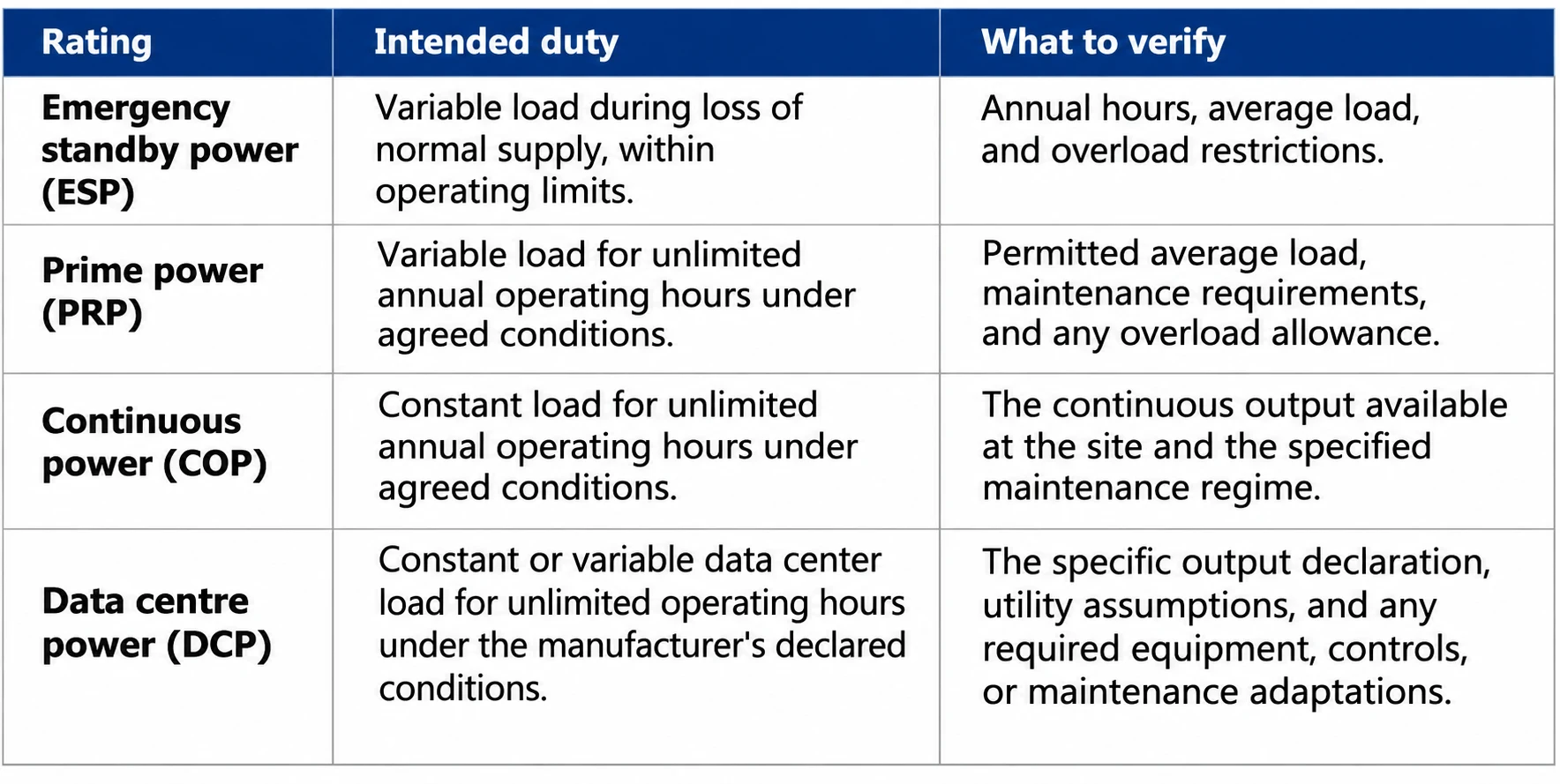
Common ISO-based ESP definitions use a 200-hour annual limit and a 24-hour average load limit of 70% of the ESP rating. PRP permits unlimited annual hours but still has an average-load condition. The same advertised kilowatt figure can therefore describe different operating capabilities. Confirm the precise declaration for the selected set. Caterpillar: Understanding Generator Set Ratings
“Unlimited hours” describes a rating category. It does not eliminate maintenance, fuel requirements, environmental limits, or operating permits.
Obtain a written rating declaration
For DCP, obtain the manufacturer’s written declaration of the output available for the intended site and duty, including any required changes to hardware, controls, or maintenance.
The ISO DCP definition refers to the availability of a reliable utility supply and excludes prolonged operation in parallel with the utility. Review those limits separately if the generators will operate routinely in parallel with the grid or supply a site without reliable utility power. Cummins: Generator Set Ratings for Data Centers and Other Applications
Manufacturers also use names such as Data Center Continuous (DCC) for their own application ratings. Read the accompanying declaration rather than treating DCC, DCP, and other labels as interchangeable. Cummins, for example, defines its DCC offering in a separate technical paper. Cummins: Data Center Continuous Ratings
For the 2,500 kW ESP example, request the declared DCP output or the output under the proposed application rating. There is no generic conversion percentage that establishes it. Use the rating confirmed for the complete engine, alternator, cooling, and control package under the specified conditions.
Figure 1. Rated duty, site output, transient performance, and system architecture answer different questions. A satisfactory result in one category does not establish the others.
Confirm output at the actual site
Size the plant using the net power available to the load under the project’s environmental conditions. Confirm how the quoted output accounts for altitude, maximum ambient temperature, airflow restrictions, and auxiliary power consumption.
Assess the engine, alternator, and cooling system as a complete package. An engine rating by itself does not demonstrate that the enclosed set can deliver the same output with the site’s ventilation arrangement.
If the project needs extended operation, establish how fuel delivery, maintenance, and replacement parts will be managed. A suitable power rating is essential, but sustained supply also depends on these supporting arrangements.
Startup time and load acceptance are separate requirements
During a utility outage, the uninterruptible power supply (UPS) typically keeps its connected loads supplied while generation starts. Power restoration includes failure detection, generator startup, voltage and frequency buildup, any required synchronization, switching, and load application.
Where NFPA 110 Type 10 applies, the ten-second classification concerns restoration of acceptable power at the transfer-switch load terminals. It includes the system’s sensing and transfer delays, not just engine acceleration. Applicability depends on the adopted requirements and the project. Cummins: 10-Second Time to Readiness
Applying load causes transient changes in voltage and frequency. Specify the maximum deviations and recovery times that the connected equipment can tolerate, along with the load steps and sequence to be tested. A no-load startup record cannot demonstrate that performance.
The load schedule should include UPS input demand, battery recharging, cooling equipment, and other essential auxiliaries. A project may need staged loading; another may require a larger single step. A DCP rating alone does not establish whether the set meets the project’s transient limits or can accept 100% of rated load in a single step.
Assess the UPS load and the complete redundancy design
UPS input behavior varies with topology, filters, loading, and settings. Avoid treating every UPS as a capacitive load or assuming that a single power-factor value covers all operating states. Assess how the selected UPS and distribution system pass through or buffer rapid changes in IT demand.
Check the proposed N+1, 2N, or 2(N+1) arrangement against the required maintenance and failure scenarios. Fuel systems, controllers, switchgear, and distribution paths can introduce shared dependencies.
Uptime Institute describes Tier III as concurrently maintainable and Tier IV as fault tolerant. A DCP label alone does not establish those characteristics or demonstrate Tier compliance. If certification is a project objective, obtain the required manufacturer capacity statements and assess the complete design against the certification requirements. Uptime Institute: Tier Classification System
Request four sets of evidence
For project discussions with LETON POWER, organize the technical submission around four items:
- Rating declaration:model, frequency, declared duty and output, environmental conditions, and operating limits.
- Performance evidence:load steps, voltage and frequency deviations, recovery times, and the relevant UPS operating conditions.
- System design:single-line diagram, startup and transfer sequence, protection coordination, and capacity available during maintenance or failure.
- Operating plan:runtime without refueling, maintenance, local emissions requirements, and approval for any alternative fuel, such as hydrotreated vegetable oil (HVO).
With this information, the project team can compare each proposal on the power available at the site and the performance supported by test evidence.

