
What operators should check across cooling, backup power, water, fuel, and site access
As El Niño strengthens, data center operators preparing for late 2026 and early 2027 need to assess the implications for power and cooling at each site.
In its October 21, 2026 seasonal update, the World Meteorological Organization (WMO) forecast further strengthening for November 2026–January 2027, with warming in the equatorial Pacific expected to peak around December. WMO’s October 8 announcement put the likelihood of El Niño persisting through February 2027 at close to 100%. These are forecasts about the climate system, not predictions of a particular outage or flood at an individual facility. WMO October 21 update, WMO October 8 announcement
A preparedness review should examine how failures in one system can affect the others. A generator may start successfully while floodwater has disabled its distribution path. A cooling plant may have enough installed capacity but lose that margin during sustained heat or a water restriction. Fuel on site may be adequate for the first day of an outage while damaged roads delay the next delivery.
Start with the local forecast and the site’s exposure
El Niño is the warm phase of the El Niño–Southern Oscillation (ENSO), involving ocean and atmospheric changes in the tropical Pacific. Its effects differ by region and season, and other climate drivers also influence the outcome.
On October 15, 2026, the US National Oceanic and Atmospheric Administration (NOAA) issued its Climate Prediction Center seasonal outlook. For November 2026–January 2027, it favored warmer conditions across the northern tier and western third of the contiguous United States. It also favored wetter conditions across much of California, the Southwest, the southern states, and the eastern seaboard. These are probabilities for seasonal averages, not a guarantee of conditions on any given day. NOAA seasonal outlook, issued October 15, 2026
Operators with multiple data centers need a separate risk assessment for each location. Combine the latest national and local forecasts with flood exposure, water-supply conditions, utility information, and the facility’s operating limits. A broad regional signal is a reason to investigate a hazard, not proof that the site will experience it.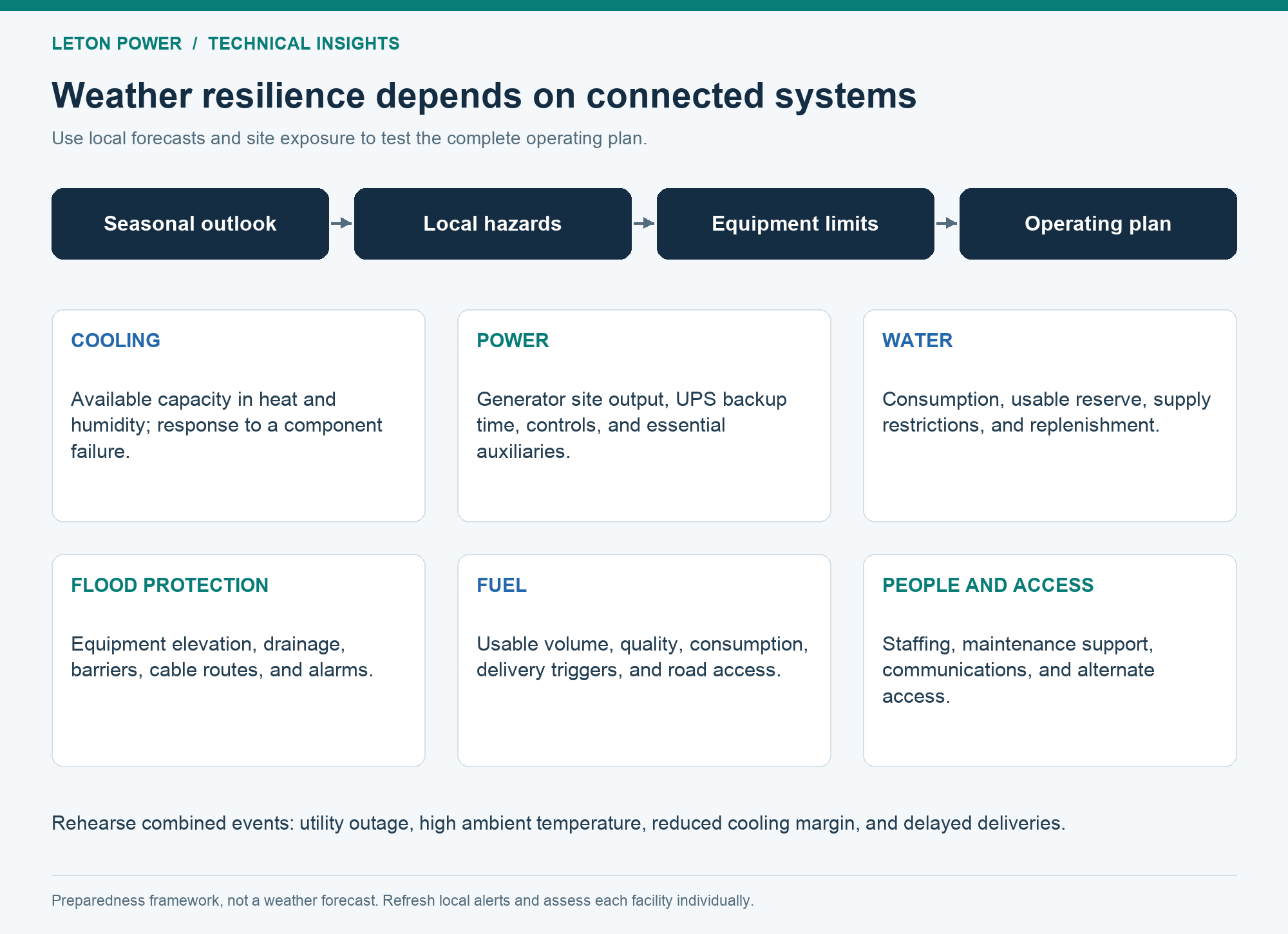
Figure 1. Weather preparedness needs to cover interacting systems and the resources that sustain them during an extended disruption.
Check cooling capacity in heat and humidity
Check air-cooled heat-rejection equipment against the site’s maximum outdoor dry-bulb temperature. Sustained heat can reduce available cooling capacity and increase the energy needed to remove the same IT heat load.
For cooling towers and evaporative systems, assess wet-bulb temperature, which accounts for both air temperature and humidity. Higher wet-bulb temperatures limit evaporative heat rejection. Water shortages create an additional risk for systems that consume cooling water. Lawrence Livermore National Laboratory examines these risks in a report available through the US Cybersecurity and Infrastructure Security Agency. Drought and Extreme Heat Impacts to Data Centers in Northern California
Review the cooling capacity available under the site’s extreme operating conditions, including the reserve remaining when a component is out of service. Check chillers, towers, condensers, pumps, controls, and the equipment needed to reject heat outdoors.
Liquid cooling changes how heat is collected from IT equipment, but it does not remove the need to reject that heat from the facility. For liquid-cooled installations, include coolant distribution units (CDUs), pump availability, flow, pressure, filter condition, and leak detection in the review. Verify the complete path from the IT equipment to the final heat-rejection system.
Plan for power interruptions and reduced generator output
Growing demand is making power availability an increasingly important planning issue. The International Energy Agency’s 2026 central projection puts global data center electricity consumption at approximately 950 TWh in 2030, up from 485 TWh in 2025. IEA: Key Questions on Energy and AI
Heat can coincide with higher regional demand for air conditioning. Drought may constrain some hydropower resources, while flooding and strong winds can damage transmission or distribution equipment. The relevant exposure depends on the local electricity system.
Check the generator plant’s usable output at the site’s ambient temperature and altitude. Engine output, alternator capability, and cooling performance all need to be assessed against manufacturer data. There is no single derating percentage that applies to every installation. Cummins’ application manual specifically addresses the effect of site conditions on these systems. Cummins: Liquid-Cooled Generator Set Application Manual
Inspect radiators, coolant systems, ventilation openings, and discharge paths. Check for airflow restrictions and the recirculation of hot discharge air. If several sets lose usable output during the same heat event, the plant may have less reserve capacity than the original calculation assumed.
Verify the transfer to generator-backed power
Verify how the uninterruptible power supply (UPS) keeps connected critical loads supplied as generators start and the site transfers to generator power. Review battery condition and backup time at the expected load. Check battery temperature management and cooling for the UPS power electronics.
For a plant with generators operating in parallel, verify startup, synchronization, load sharing, and standby-unit availability. Check the response when a set fails to start or trips after taking load. Include automatic transfer switches, switchgear, control power, and the equipment needed to supply essential cooling.
Use a controlled test plan to verify the sequence across these systems. Record the time to establish generator supply, the load applied, voltage and frequency behavior, and the UPS response. Confirm that the tested load and configuration represent the operating conditions the facility needs to withstand.
Protect the supply paths for power, fuel, and water
Flood exposure includes electrical rooms, cable trenches, generator foundations, fuel installations, and cooling equipment. Review drainage, barriers, sump pumps, water-level alarms, and the routes by which water could reach critical equipment.
Assess the complete supply path. Keeping the generator dry is insufficient if water can disable a switchboard or prevent safe fuel transfer. Check the exposure of tanks, pumps, vents, fill connections, and controls as part of the site review.
Plan fuel reserves using the usable fuel volume and expected consumption at the supported load. Set a replenishment trigger that allows for delivery delays. Review fuel quality, water contamination, supplier arrangements, and whether alternative delivery routes are practical during a regional disruption.
Water planning needs the same operational detail. For systems that consume cooling water, establish the usable reserve, expected demand, replenishment arrangements, and the response to a restriction or supply interruption.
Rehearse conditions that affect several systems at once
Extreme weather can produce overlapping problems: a utility outage during high ambient temperatures, reduced cooling margin, blocked access, and delayed fuel delivery. Test the emergency plan against a credible combination of those conditions.
Define who makes load-reduction decisions, how alarms are escalated, how staff reach the facility, and how maintenance support is obtained if normal access is disrupted. Remote monitoring helps only while its power and communication paths remain available.
For new facilities, bring these questions into site selection and design. Evaluate climate exposure alongside power capacity, water availability, distribution layout, equipment placement, and expansion requirements. For existing facilities, use seasonal reviews to identify gaps that need an operating change, a test, or an engineering modification.
For project discussions with LETON POWER, provide site temperatures and altitude, the supported load, required runtime without refueling, redundancy objectives, and access constraints. Use these inputs to define the site rating, supporting equipment, and operating requirements for the backup-power system.

