
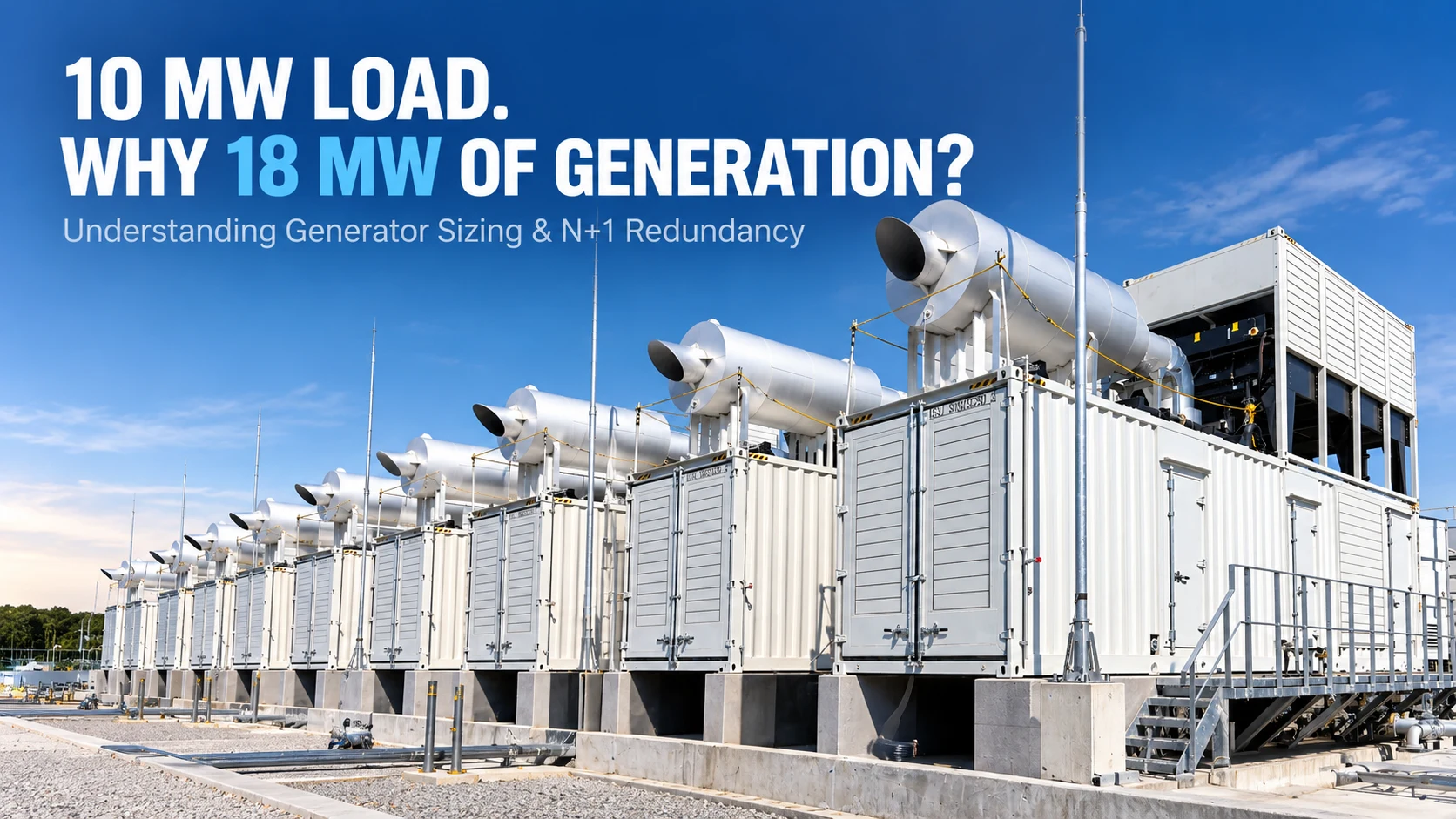
How generator size and redundancy requirements affect the capacity you need to buy
A customer asks for 10 MW of power. The proposed generator plant has 12.5 MW of installed capacity. Another proposal for the same load comes in at 18 MW.
Both figures can make sense. The difference may come from the size of each generator and the requirement to keep supplying the load after one unit fails.
For an off-grid facility that depends on generators for continuous power, matching installed capacity to normal demand leaves no spare generation. A 10 MW plant supplying a 10 MW load will have to shed load whenever a unit becomes unavailable, unless another source can cover the shortfall.
Before comparing quotations, establish the customer’s requirement: must the facility still receive 10 MW after its largest generator is lost?
Four generator arrangements for the same load
Consider a simplified plant with a 10 MW critical load. Assume that each unit can deliver its stated usable output continuously, that any one generator may become unavailable, and that neither the grid nor storage provides a sustained replacement supply. Auxiliary demand, environmental derating, electrical losses, and overlapping maintenance are excluded from this initial calculation.
For identical units, N is the minimum number needed to carry the load. N+1 adds one unit so that enough generating capacity remains after any one unit is lost.
With 4.5 MW units, three generators provide 13.5 MW in normal operation, but losing one leaves only 9 MW. A fourth unit is needed to retain at least 10 MW after a single-generator failure.
Its 18 MW installed total is 80% above the load. That percentage includes both the spare unit and the unused capacity created by the size of the modules. It is not a standard N+1 margin that should be applied to other projects.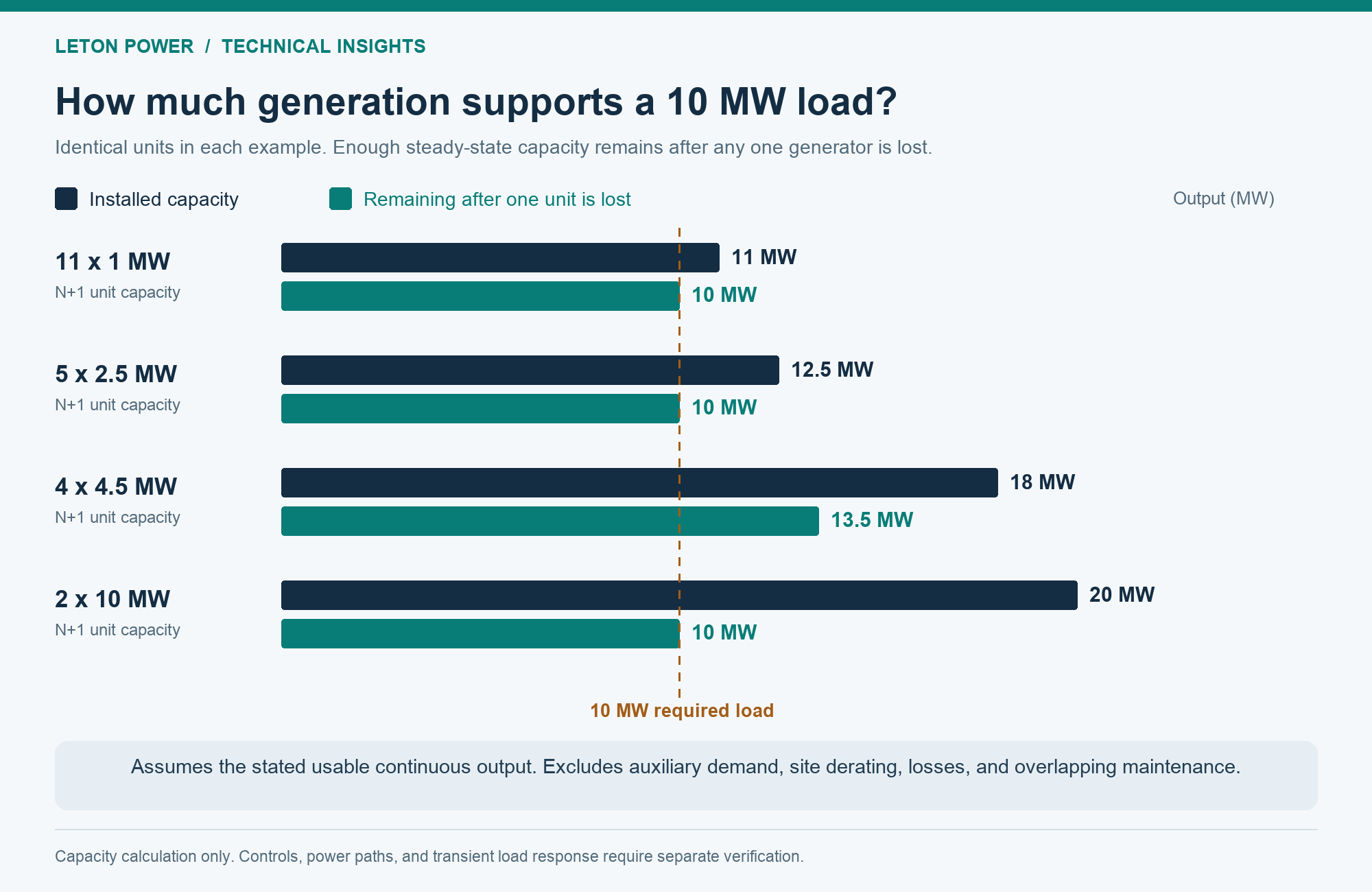
Figure 1. Each example retains at least 10 MW of steady-state generating capacity after one unit is lost. The calculation uses the assumptions stated above; it does not establish complete system reliability.
Smaller units allow capacity to be added in finer increments. They also increase the number of engines, breakers, exhaust connections, cooling systems, and maintenance tasks. The option with the least surplus capacity may still have a higher installed cost or a more demanding operating arrangement.
An extra generator addresses only part of the system
Caterpillar describes N+1 generation as the units needed for the load plus one additional unit. Its guidance also shows how a central paralleling controller can become a single point of failure, limiting the benefit of spare generation. Caterpillar: Distributed Synchronization and Paralleling Control
A plant with eleven 1 MW generators passes the simple capacity check. It still needs a system review. A common bus fault, failed control power supply, or unavailable fuel-transfer system could prevent several otherwise healthy units from serving the load.
That review should follow the power path and the systems that keep it operating. Examine the switchgear, transformers, controls, fuel supply, and cooling arrangements. For gas-engine plants, include gas pressure regulation and treatment. Check whether critical components can be isolated for maintenance and what happens when a controller or communication link fails.
Fuel-system redundancy deserves particular attention. Uptime Institute gives the example of a single valve between redundant pumps or tanks: the pumps may be duplicated, yet maintenance of the shared valve can still require an unacceptable shutdown. Uptime Institute: Fuel System Design and Reliability
The operating sequence matters as well. The remaining generators need to accept the redistributed load without exceeding the permitted voltage and frequency excursions. During a black start, the controls must determine which unit can establish the bus and how subsequent units join it. Spare megawatts alone do not demonstrate that these transitions will succeed.
There is also an important boundary to the N+1 calculation. One unit under maintenance plus a second unit failing represents two unavailable units. Ordinary N+1 capacity does not necessarily cover that condition. If the project requires it, the design must provide additional capacity, another power source, a different distribution arrangement, or an agreed load-shedding response.
Compare the cost of capacity that remains available
The cost of spare generation extends beyond the engine. Additional units may require more switchgear, cooling, exhaust equipment, transformers, emissions controls, installation work, and maintenance support.
A rough estimate multiplies the surplus kilowatts by an assumed installed cost per kilowatt. Against a 10 MW load, the examples add 1,000, 2,500, 8,000, or 10,000 kW respectively. The cost per kilowatt is unlikely to be identical across these configurations, so this calculation helps explore the cost impact but cannot replace a detailed quotation.
A more useful metric for comparing proposals is:
Total installed plant cost ÷ usable net capacity remaining after the defined failure
For this purpose, usable capacity means power that can reach the agreed delivery point under the specified site conditions and operating duty. Each proposal should use the same definition of the load, the same failure scenario, and the same engineering scope.
Generator efficiency still matters, especially for continuous operation. Its value must be assessed alongside spare capacity, part-load operation, fuel costs, and maintenance. A larger unit’s efficiency advantage may be offset by the cost of duplicating it; a plant with many smaller units may cost more to install and maintain.
Specify exactly what 10 MW means
The phrase “10 MW” can describe several different commitments:
- The sum of the generators’ nameplate ratings.
- Gross electrical output before plant auxiliary demand and agreed losses.
- Net power delivered to the facility in normal operation.
- Net power delivered after a defined single-generator failure.
- A normal operating target that may be reduced when equipment is unavailable.
These commitments imply different equipment quantities and operating responsibilities. They should be resolved before suppliers are asked to price a complete plant.
Also establish whether 10 MW refers to the IT load or the entire facility. Cooling, UPS losses, battery charging, and other supported loads may sit outside an IT-only figure and still need power from the generator plant.
Some computing workloads can tolerate controlled curtailment. Such a project may accept a temporary reduction in processing capacity when a generator stops, trading lower initial investment for lost output during the interruption. A critical data center or an industrial process may have a different requirement. The acceptable operating response should be part of the specification.
Battery storage can bridge a transition or provide reserve for a defined period. Its contribution depends on both its power rating and usable energy. It should not be counted as an indefinite substitute for a failed generator without demonstrating how the plant will sustain the load afterward.
Make the quotation match the operating requirement
When discussing a project with LETON POWER, define the load and the required response to a failure before settling on generator size or brand.
A 10 MW project does not automatically require four identical 4.5 MW units. Alternatives may include smaller modules, a mixed-size plant, separate load blocks, or support from another qualified source. Each arrangement needs the same check: after the specified equipment is unavailable, can the remaining system deliver the required net power and handle the transition?
A useful quotation makes these conditions clear. The customer should be able to see how much power the plant provides in normal operation, what remains after a failure, and which assumptions support those figures.

