
I see new generation data center solutions leading the way for 2026, with hyperscale cloud providers and advanced modular systems shaping the landscape. Selecting the right data center solutions is critical for future-proofing it infrastructure. I focus on performance, security, energy efficiency, integration, support, cost, and innovation to guide my decisions. Companies now run half their workloads in public clouds, with over 94% using cloud services. Flexible new generation data center platforms offer scalability and strong security, helping organizations adapt to rapid changes and protect their data.
Key Takeaways
- New generation data centers prioritize performance, security, and energy efficiency to meet future demands.
- Hyperscale cloud providers like AWS and Google Cloud lead the industry with scalable, on-demand resources.
- LETON POWER is recognized for its reliable power solutions, ensuring zero downtime for critical operations.
- Sustainability is essential; data centers must adopt energy-efficient technologies and renewable energy sources.
- AI and automation enhance data center operations by predicting failures and optimizing resource allocation.
- Modular designs allow data centers to scale quickly, adapting to changing workloads and business needs.
- Compliance with security standards like ISO 27001 is crucial for protecting sensitive data and maintaining trust.
- Cost-effective solutions should balance upfront investments with long-term savings through innovative technologies.
Leading New Generation Data Center Solutions

Top Data Center Solution Companies
When I look at the top data center solution companies for 2026, I see a mix of established technology giants and innovative specialists. These companies set the pace for the industry and drive the adoption of next-generation technologies.
Hyperscale Cloud Providers
Hyperscale cloud providers lead the transformation of the data center industry. I see Amazon Web Services (AWS), Google Cloud, Microsoft Azure, IBM Cloud, and Oracle Cloud as the main players. They operate massive global infrastructures that deliver flexible, on-demand resources. Their platforms support AI workloads, edge deployments, and rapid scaling for enterprises of all sizes. Hyperscale providers invest heavily in automation, security, and energy efficiency, which sets new standards for the entire sector.
LETON POWER Overview
I recognize LETON POWER as a global leader in reliable power solutions for data centers. LETON POWER stands out with over 20 years of expertise and more than 33 GW of installed capacity worldwide. I value their commitment to zero downtime, which is critical for hyperscale and edge data center operations. LETON POWER offers advanced diesel generator sets, modular power systems, and integrated microgrid solutions. Their technology supports high-density, always-on environments and meets strict sustainability standards. LETON POWER’s global presence and 24/7 support make them a trusted partner for mission-critical infrastructure.
Other Industry Leaders
I also consider several other companies as leaders in the data center space. These organizations deliver innovative hardware, software, and services that power modern facilities:
- Cisco Systems
- HPE (Hewlett Packard Enterprise)
- Dell Technologies
- Huawei
- Schneider Electric
- Vertiv
- Supermicro
- Lenovo
- Nutanix
- Arista Networks
- Johnson Controls
- Broadcom
These companies focus on performance, security, and sustainability, which are essential for next-generation data center solutions.
Key Features of New Generation Data Centers
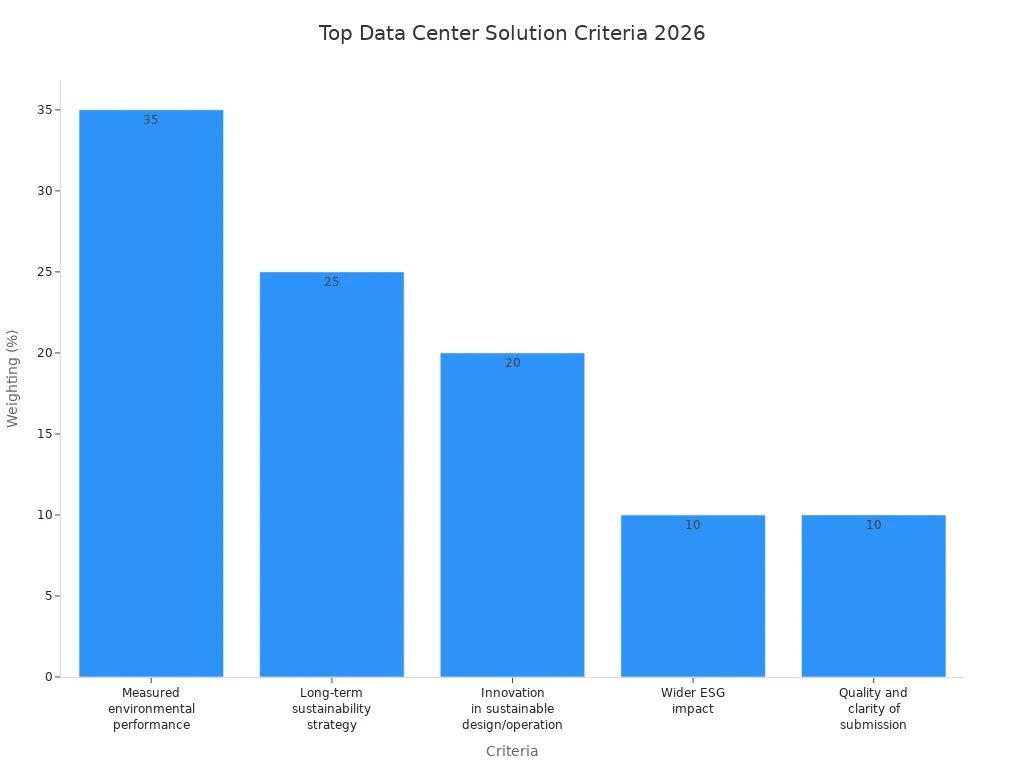
I evaluate top data center solution companies using strict criteria. The table below shows the main factors that matter most in 2026:
| Criteria | Weighting (%) |
|---|---|
| Measured environmental performance (PUE, WUE, carbon, renewables, waste) | 35 |
| Long-term sustainability strategy and roadmap | 25 |
| Innovation in sustainable design and/or operation | 20 |
| Wider ESG impact (community, workforce, governance) | 10 |
| Quality and clarity of submission | 10 |
I see several advancements that define a new generation data center. These include high-performance computing, massive storage, and blazing-fast networking. Specialized cooling and intelligent power management keep hyperscale facilities running efficiently. Modularity and scalability allow data centers to adapt quickly to new AI and edge computing demands.
Next-generation data centers integrate AI, edge computing, modularity, and sustainability at their core. I notice that AI and edge computing drive higher performance and energy efficiency. Sustainability is now a design requirement, not just a goal. Modular architectures and tailored silicon make it possible to scale and optimize for specific workloads. These features ensure that data centers remain reliable, flexible, and ready for the future.
Data Center Industry Evaluation Criteria
Performance & Scalability
When I evaluate solutions in the data center industry, I start with performance and scalability. These factors determine how well a data center can handle demanding workloads and grow with business needs. I look at metrics such as FLOPS, memory bandwidth, latency, and cluster size. These indicators show how much computing power and responsiveness a facility can deliver. I also consider scale-up and scale-out bandwidth, which reveal how easily a data center can expand within a node or across multiple nodes. The ability to scale quickly is essential for supporting AI workloads and meeting unpredictable demand.
| Metric | Description |
|---|---|
| FLOPS | Measures floating-point operations per second, indicating computational performance. |
| Memory Bandwidth | Represents data transfer rates within the memory hierarchy, crucial for performance. |
| Memory Capacity | Reflects the storage capacity available in each memory tier. |
| Latency | Indicates the minimum delay in data transfer, affecting responsiveness. |
| Scale-up Bandwidth | Describes intra-node bandwidth capabilities, important for scaling performance. |
| Scale-out Bandwidth | Describes inter-node bandwidth capabilities, essential for distributed systems. |
| Cluster Size | Denotes the number of nodes within each system, impacting overall scalability. |
I notice that AI-focused data centers require higher energy levels, which impacts site viability. Developers must assess grid capacity and plan for future growth. Redundancy layers are vital to avoid downtime and maintain reliability.
Security & Compliance
Data center security and compliance have become top priorities in the data center industry. I always check for the latest standards and protocols to protect sensitive data and ensure regulatory alignment. Leading providers adopt standards such as ISO 27001, SSAE 16, PCI DSS, HIPAA, and GDPR. These frameworks help maintain robust security practices and transparency.
| Compliance Standard | Description |
|---|---|
| ISO 27001 | A standard for information security management systems, ensuring robust data security practices. |
| SSAE 16 | Focuses on controls and processes within a data center, providing transparency in operational integrity. |
| PCI DSS | Ensures stringent security measures for payment card information, protecting sensitive financial data. |
| HIPAA | Protects sensitive patient health information, requiring confidentiality, integrity, and availability measures. |
| GDPR | A regulation for data protection and privacy in the EU, mandating strong security measures and breach notifications. |
I rely on encryption, firewalls, and monitoring systems to safeguard data center operations. Compliance with new regulations is increasingly important as governments introduce stricter standards. I see that developers must navigate rules on building height, air quality, and noise levels. These requirements shape the evaluation criteria for data center solutions.
Energy Efficiency & Sustainability
Energy efficiency and sustainability now define success in the data center industry. I use metrics like Energy Reuse Factor (ERF), Carbon Usage Effectiveness (CUE), and Water Usage Effectiveness (WUE) to measure progress. These benchmarks help me track how much energy is reused, the environmental impact of energy consumption, and water efficiency.
| Metric | Calculation | Unit | Goal | Measures |
|---|---|---|---|---|
| Energy Reuse Factor (ERF) | Reused Energy / Total Energy | Percentage | Maximize | How much energy in the data center is reused elsewhere |
| Carbon Usage Effectiveness (CUE) | CO2 Emissions / IT Energy | kg CO2 / kWh | Minimize | What the overall sustainability of a data center is |
| Water Usage Effectiveness (WUE) | Water Usage / IT Energy | Ratio | Minimize | How efficiently water is being used in the data center |
I see sustainability benchmarks becoming crucial for data centers in 2026. The GRESB Data Center Assessment will set a global standard for sustainability, reflecting the growing importance of these aspects. Investors now focus on execution risk and reliability, making energy management and automation key evaluation criteria for data center solutions.
Integration & Support
I always pay close attention to integration and support when I evaluate data center solutions. Seamless integration ensures that new systems work smoothly with existing infrastructure. Strong vendor support helps me resolve issues quickly and maintain high uptime. I look for providers who offer tailored engineering and pre-assembled solutions. These features reduce the need for on-site contractors and improve safety.
- Vertiv’s acquisition of E+I Engineering Group expanded their engineering capabilities. This move allows for more customized solutions that fit unique data center requirements.
- Pre-wired and assembled systems arrive ready for installation. This approach saves time and reduces the risk of errors during setup.
- When companies reduce outsourcing for fabrication, deployment speeds increase. Product quality also improves, which is critical for reliable data center operations.
I value vendors who provide 24/7 technical support and predictive maintenance. These services help me avoid downtime and keep my data center running efficiently. Remote monitoring and lifecycle management give me peace of mind. I can track system status from anywhere and address problems before they affect operations.
Integration also means compatibility with building management systems and cloud platforms. I look for solutions that support real-time monitoring and easy upgrades. This flexibility allows my data center to adapt to new technologies and changing business needs.
Cost & Innovation
Cost and innovation drive my decisions when I choose data center solutions. I want to maximize value while staying ahead of industry trends. New generation data centers introduce creative ways to save money and boost efficiency.
- Many data centers now co-locate with renewable energy sources like solar and wind. This strategy lowers energy costs and supports sustainability goals.
- The “Bring Your Own Power” model lets data centers finance their own energy needs. This approach leads to long-term savings and greater control over energy supply.
- Advanced technologies such as small modular reactors and next-generation geothermal energy offer new ways to reduce energy expenses.
I see closed cooling systems becoming more common. These systems minimize water usage and keep servers at optimal temperatures. AI-powered management tools help me optimize energy use and reduce power loss during transmission.
- Providers focus on reducing initial energy consumption and increasing flexibility. Fast delivery of energy supply at lower costs ensures my data center meets demand without overspending.
Innovation also means modular designs and smart microgrids. These features allow me to scale my data center quickly and efficiently. I look for solutions that support future growth and adapt to new workloads, such as AI and edge computing.
Cost-effective solutions must balance upfront investment with long-term savings. I always consider the total cost of ownership, including maintenance and energy expenses. By choosing innovative technologies, I ensure my data center remains competitive and ready for future challenges.
Comparing Top Data Center Solution Companies
Strengths & Weaknesses
I compare the strengths and weaknesses of top data center solution companies by looking at their performance, security, energy management, integration, cost, and innovation. Each company brings unique advantages to the table. I see that some focus on high-density AI workloads, while others excel in networking or sustainability. My experience shows that matching these strengths to business needs is essential for success.
Performance Comparison
Performance remains a top priority for every data center. I rely on metrics like server delivery speed, cooling capacity, and AI workload optimization to judge each provider. The table below shows how leading companies stack up:
| Company | Performance Score | Strengths | Target Customers |
|---|---|---|---|
| Supermicro | 83.7 | Agile AI server delivery, modularity, liquid cooling up to 250 kW | Customers needing modular, high-density AI servers |
| Dell | 80.8 | Broad SKU coverage, advanced cooling up to 480 kW | Enterprises scaling AI workloads, seeking comprehensive support |
| HPE | 79.0 | Advanced AI interconnect, subscription-based HPC-as-a-Service | Organizations needing scalable, enterprise-grade AI infrastructure |
| Lenovo | 75.7 | Vertically integrated supply chain, flexible payment models | Cost-conscious enterprises and public sector buyers |
| Cisco | 69.4 | Strong networking and software stack, proven infrastructure security | Users prioritizing network integration and service flexibility |
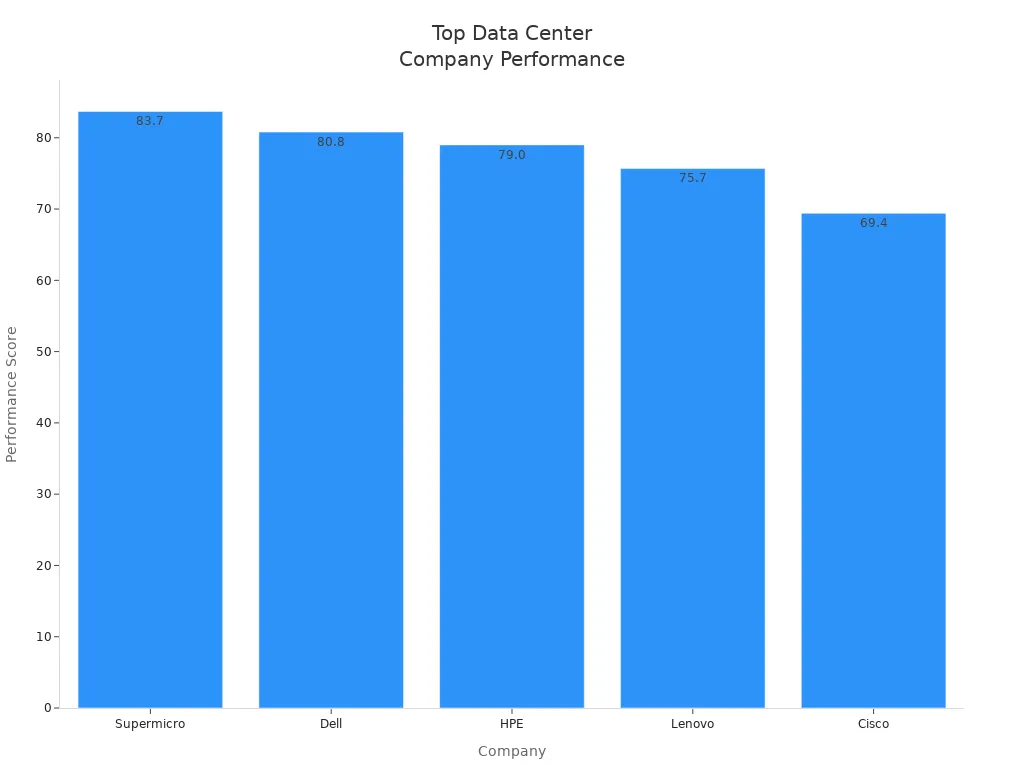
I notice that Supermicro leads in modularity and liquid cooling, which supports high-density AI clusters. Dell offers broad product coverage and advanced cooling, making it ideal for enterprises with diverse needs. HPE stands out with scalable AI interconnects and flexible service models. Lenovo appeals to buyers who want cost-effective solutions and supply chain reliability. Cisco provides robust networking and security, which is critical for data center environments that prioritize connectivity.
Security Features
Security shapes every decision I make in the data center industry. I look for companies that invest in strong encryption, access controls, and compliance certifications. Cisco impresses me with its infrastructure security and software stack. Dell and HPE also deliver comprehensive security features, including real-time monitoring and automated threat detection. LETON POWER supports secure operations by integrating remote monitoring and event logging into its power systems. I value providers who meet global standards like ISO 27001 and GDPR, ensuring data protection and regulatory compliance.
Tip: I always recommend choosing solutions with built-in security monitoring and regular compliance updates. This approach helps prevent breaches and keeps sensitive information safe.
Energy & Sustainability
Energy efficiency and sustainability drive innovation in the data center sector. I see LETON POWER leading with its advanced diesel generator sets, compatibility with renewable fuels, and integrated microgrid solutions. Supermicro and Dell push the envelope with liquid cooling and energy reuse technologies. HPE and Lenovo focus on reducing carbon footprints through efficient hardware and supply chain management. I prefer companies that offer modular designs and support for battery energy storage systems, which help optimize energy use and lower costs.
Integration & Support
Integration and support make a big difference in data center operations. I choose vendors who provide seamless compatibility with existing infrastructure and cloud platforms. Dell and HPE offer tailored engineering and pre-assembled systems, which speed up deployment and reduce errors. LETON POWER stands out with end-to-end lifecycle support, global commissioning, and 24/7 technical assistance. Cisco’s networking expertise ensures smooth integration with enterprise systems. I rely on remote monitoring and predictive maintenance to keep my data center running without interruption.
Cost Analysis
Cost remains a deciding factor for many organizations. Lenovo attracts cost-conscious buyers with flexible payment models and efficient supply chains. Supermicro delivers value through modular solutions that scale with demand. Dell and HPE balance upfront investment with long-term savings by offering comprehensive support and energy-efficient designs. LETON POWER helps reduce operating costs by optimizing power delivery and maintenance. I always calculate total cost of ownership, including energy, support, and upgrade expenses, before making a final decision.
Innovation & Future-Readiness
Innovation sets the leaders apart in the data center industry. I see LETON POWER driving future-readiness with smart microgrids, battery energy storage, and hydrogen integration. Supermicro and Dell invest in AI-optimized hardware and advanced cooling. HPE pioneers subscription-based high-performance computing services. Cisco continues to evolve its networking and security platforms. I look for companies that embrace modularity, automation, and sustainability, ensuring my data center stays competitive and ready for emerging technologies.
Note: I recommend evaluating each provider’s roadmap for AI, edge computing, and sustainability. This strategy helps future-proof your data center and supports long-term growth.
Scenario-Based Data Center Recommendations
Large Enterprises
I see large enterprises facing unique challenges in meeting data center demand. These organizations require solutions that deliver superior performance, enhanced security, and high scalability. I often recommend tailored data center architectures for sectors like finance and healthcare, where strict compliance is essential. Enterprise data centers support in-house storage, processing, and management, allowing IT teams to customize infrastructure for specific business needs.
| Benefit | Large Enterprises | Smaller Organizations |
|---|---|---|
| Enhanced Security | Yes | Limited |
| Customization | Yes | No |
| Regulatory Compliance | Yes | Limited |
| Performance | Superior | Standard |
| Scalability | High | Low |
I advise large enterprises to invest in hybrid cloud platforms that combine private and public resources. This approach supports rapid scaling and advanced security controls. I also recommend working with vendors who offer end-to-end lifecycle support and global commissioning. These features help maintain uptime and reliability as demand grows.
- Enterprise data centers are tailored to meet specific IT needs.
- They support strict compliance and superior performance.
- Customization and scalability are key advantages.
Cost-Sensitive Buyers
I understand that cost-sensitive buyers must balance data center demand with budget constraints. I suggest reviewing service contracts regularly to ensure they remain relevant and cost-effective. Switching to third-party maintenance contracts can reduce expenses compared to vendor agreements. I encourage focusing funding requests on risk, cost, and value to align with business priorities.
Shifting to a subscription-based operational expenditure model simplifies budgeting. I calculate expenses based on user numbers and licenses, which leads to predictable costs. This model eliminates the need to estimate hardware, maintenance, and licensing fees separately. I recommend modular hybrid cloud solutions for cost-sensitive buyers. These platforms allow organizations to scale resources as demand increases without large upfront investments.
- Review service contracts for cost-effectiveness.
- Consider third-party maintenance for better value.
- Focus funding on risk, cost, and business value.
- Use subscription-based hybrid cloud models for predictable expenses.
Tip: I always advise cost-sensitive buyers to prioritize solutions that offer flexibility and scalability. This strategy helps manage demand while controlling costs.
Edge & Hybrid Deployments
I see edge and hybrid deployments becoming more popular as organizations seek to meet growing data center demand. Edge data centers process data close to the source, reducing latency and enabling real-time analysis for IoT and smart devices. Hybrid cloud platforms allow businesses to handle time-sensitive data at the edge while using cloud resources for long-term storage and complex analytics.
- Edge data centers support low-latency processing for IoT and smart devices.
- Hybrid cloud solutions enable seamless integration between on-premises and cloud environments.
- Processing data locally reduces network strain and minimizes transmission needs.
- Robust network infrastructure is essential for hybrid deployments.
- Disaster recovery strategies differ: edge computing enhances resilience through distributed processing, while hybrid cloud leverages cloud resources for backup.
- AI optimizes resource allocation and system performance in both models.
- Hybrid cloud platforms support multi-cloud environments, optimizing data routing and scalability.
I recommend edge and hybrid cloud solutions for organizations with distributed operations or those needing real-time data analysis. These models provide flexibility, resilience, and scalability to meet evolving demand.
Sustainability-Focused Organizations
I see sustainability-focused organizations leading the charge in responsible technology adoption. These groups prioritize environmental stewardship and seek solutions that minimize resource consumption. When I evaluate options, I look for data center providers who invest in green innovation and support long-term sustainability goals.
I recommend starting with energy-efficient technologies. Many organizations upgrade to ENERGY STAR rated servers and equipment. This step reduces energy waste and improves overall performance. I also look for providers who use renewable power sources, such as solar or wind, to lower carbon footprints.
Cooling systems play a major role in sustainability. I prefer solutions that use air-side economizers or advanced liquid cooling. These technologies reduce water usage and support efficient operations. Some facilities implement water reuse strategies, including rainwater harvesting and greywater recycling. These approaches help conserve resources and lower operating costs.
I value companies that commit to green building certifications. LEED and ENERGY STAR certifications show a dedication to sustainable practices. I also support a circular economy approach to e-waste management. By promoting reuse and recycling, organizations minimize environmental impact and extend the life of their equipment.
Here are the features I prioritize for sustainability-focused organizations:
- Innovative cooling technologies that reduce water usage
- Water reuse and recycling strategies
- Investment in energy-efficient technologies and renewable power sources
- Commitment to green building certifications
- Circular economy practices for e-waste management
- Upgrading to ENERGY STAR rated servers and equipment
I often recommend hybrid solutions for organizations with sustainability goals. Hybrid models allow companies to balance on-premises and cloud resources, optimizing energy use and reducing waste. By integrating renewable energy into hybrid deployments, organizations can further lower their carbon footprint. Hybrid architectures also support flexible scaling, which helps avoid over-provisioning and unnecessary resource consumption.
The table below summarizes how hybrid solutions support sustainability:
| Feature | Benefit for Sustainability-Focused Organizations |
|---|---|
| Hybrid cloud integration | Optimizes energy use and resource allocation |
| Renewable energy compatibility | Reduces carbon footprint |
| Flexible scaling | Prevents over-provisioning |
| Advanced cooling systems | Lowers water and energy consumption |
Tip: I always encourage sustainability-focused organizations to work with vendors who offer lifecycle support and remote monitoring. These services help maintain efficiency and identify opportunities for further improvement.
Real-World Validation in the Data Center Industry
Case Studies & Success Stories
I often look for real-world examples to measure the impact of new generation solutions. Successful deployments show how advanced technologies transform operations and deliver measurable benefits. One standout case involves the first Tier III data center in Southeast Europe. This facility eliminated the need for data export and foreign compliance, which reduced costs and simplified regulatory challenges. The infrastructure supports sustainable and scalable services, aligning with environmental goals and energy efficiency targets. AI application services run smoothly, meeting high compute demands while maintaining operational efficiency. Highly elastic compute services allow the center to grow resources as needed, ensuring cost-effectiveness and energy savings.
| Feature/Outcome | Description |
|---|---|
| First Tier III data center in Southeast Europe | Eliminated data export needs and foreign compliance issues, reducing costs. |
| Sustainable and scalable infrastructure | Provided energy-efficient services while aligning with environmental goals. |
| AI application services | Supported significant compute power demands while maintaining operational efficiency. |
| Highly elastic compute services | Enabled growth of computing resources while ensuring energy efficiency and cost-effectiveness. |
I see many facilities using generative AI and autonomous robots to enhance security operations. These technologies improve decision-making and reduce human error. Spot robots detect threats and interact naturally with personnel, which increases safety and efficiency. Facial recognition features personalize the experience for employees and visitors, creating a secure and welcoming environment.
- Enhanced security operations through generative AI and autonomous robots.
- Improved decision-making and reduced human error in security procedures.
- Spot robots detect security threats and interact naturally with personnel.
- Facial recognition features personalize the experience for employees and visitors.
Industry Benchmarks & Reports
I rely on industry benchmarks and reports to validate the effectiveness of new generation solutions. These resources provide objective data and help me compare performance across different providers. Benchmarks measure uptime, energy efficiency, and sustainability. Reports highlight trends in AI adoption, modular design, and renewable energy integration. I use these insights to guide my recommendations and ensure that solutions meet current standards.
Many organizations publish annual sustainability assessments. These documents track progress in energy reuse, carbon reduction, and water conservation. I study these reports to identify leaders in innovation and reliability. Benchmarking helps me set realistic goals and evaluate new technologies before making investments.
Note: I always recommend reviewing independent benchmarks and third-party reports when selecting a solution. These resources offer valuable insights and support informed decision-making.
Trends Shaping New Generation Data Centers

AI & Automation
I see artificial intelligence and automation driving major changes in the data center industry. AI now predicts hardware failures by analyzing historical data, which helps prevent costly downtime. I rely on AI to allocate resources based on real-time demand, optimizing performance and reducing expenses. Automated workload management improves efficiency and responsiveness, allowing me to meet business needs quickly. AI also enhances security by detecting threats through behavioral analysis. I use AI to automate network management tasks, which boosts operational performance and reduces manual monitoring. AI systems manage bandwidth allocation and predict equipment failures, making my operations more reliable.
- AI predicts hardware failures and prevents downtime.
- AI allocates resources dynamically, optimizing costs.
- AI automates workload management for better efficiency.
- AI improves security by detecting threats in real time.
- AI manages network tasks and bandwidth allocation.
Cooling & Power Innovations
I notice that cooling and power management have become central to data center trends. Companies now introduce advanced solutions to address high-density workloads and sustainability goals. I use the latest cooling technologies to maintain optimal temperatures and reduce energy consumption. The table below highlights innovations from leading providers:
| Company | Innovations and Features |
|---|---|
| Trane | TRACE®, myPLV®, myCO2e™ software tools, LiquidStack immersion cooling, Autodesk partnership; high-efficiency HVAC, predictive software tools, circular service program. |
| Danfoss | Direct-to-chip cooling, Leanheat software, heat reuse, Net Zero Innovation Hub partnerships; proven PUE improvements, strong in North America and EU. |
| Carrier | Lifecycle management for facility optimization, customizable solutions, sustainability initiatives including packaging reuse and recycling. |
| Daikin | Cooling-as-a-Service, refrigerant management, equipment reuse, responsible takeback programs; circular economy initiative saving refrigerant and carbon emissions. |
I see high-density colocation supporting AI workloads, which pushes the need for innovative cooling and power systems. I choose solutions that help my data center adapt quickly and meet future demands.
Security & Compliance Evolution
Security and compliance requirements continue to evolve rapidly. I must keep up with stricter data privacy regulations such as GDPR and CCPA. Compliance certifications like ISO/IEC 27001 have become essential for maintaining trust and transparency. Government policies now influence sustainability and energy efficiency, shaping how I develop and operate my data center. The table below summarizes key changes:
| Regulation Type | Key Changes | Implications |
|---|---|---|
| Cybersecurity Standards | Stricter standards introduced | Enhanced security measures required for compliance |
| AI Regulations | Emergence of AI-specific regulations | Increased transparency and documentation of AI workloads |
| Sustainability Directives | New reporting requirements for operational efficiency | Focus on energy and water usage optimization |
I see that new generation data center trends include a strong focus on compliance and sustainability. I prioritize solutions that help me meet these evolving standards and maintain operational excellence.
Edge & Micro Data Centers
I see edge and micro data centers transforming how organizations manage distributed computing. These compact, self-contained facilities deliver essential networking, compute, and storage functions. Their smaller footprint allows me to deploy them at the edge of the network, which is critical for applications that require immediate data processing near the source.
When I evaluate the advantages of edge and micro data centers, several benefits stand out:
- Reduced latency by processing data closer to the source.
- Lower bandwidth requirements, which helps minimize costs associated with data transmission.
- Increased reliability, especially in environments with unstable network connections.
- Flexibility in deployment, allowing installation in a wide range of spaces.
I often recommend edge and micro data centers for organizations that operate in environments where traditional facilities are not practical. For example, retail locations depend on on-demand service and must maintain continuous operations, even during network disruptions. Schools and banks often face space constraints, making it difficult to install large-scale infrastructure. In remote areas, local processing becomes essential to maintain operations despite unreliable connectivity.
Edge and micro data centers support several deployment scenarios:
- Retail locations where on-demand service is critical, ensuring continuous operations even during network disruptions.
- Environments with space constraints, such as schools and banks, where traditional data centers cannot be deployed.
- Remote areas where local processing is essential for maintaining operations despite connectivity issues.
I have seen these solutions play a vital role in supporting distributed computing needs. By processing data locally, organizations can respond faster to customer demands and reduce the risk of downtime. This approach also helps optimize resource allocation and improve overall system performance.
Micro data centers offer a practical solution for businesses that need to scale quickly and adapt to changing requirements. Their modular design allows me to add capacity as needed, without major infrastructure changes. I find that edge deployments are especially valuable for supporting IoT devices, smart sensors, and real-time analytics. These technologies rely on immediate data processing to deliver actionable insights.
Tip: I always advise organizations to assess their operational environment before choosing an edge or micro data center solution. Understanding local connectivity, space limitations, and latency requirements helps ensure the right fit for each scenario.
Edge and micro data centers continue to shape the future of distributed computing. Their flexibility, reliability, and efficiency make them an essential part of modern IT strategies.
I see that choosing the right data center solution depends on power availability, labor resources, and community engagement. I align my technology choices with business strategy by collaborating with leaders and investing in scalable systems. I recommend evaluating sites for infrastructure, running power reliability simulations, and working with environmental teams. Modular deployments and energy efficiency will shape the future, as organizations seek rapid growth and better control over sensitive workloads.
FAQ
What makes a data center solution “next-generation”?
I look for advanced features like AI integration, modular design, and sustainability. These solutions support hyperscale data centers and deliver high performance, security, and energy management.
How do I evaluate total cost of ownership for my data center?
I calculate hardware, software, maintenance, and energy costs. I also consider cloud infrastructure optimization and long-term savings from efficient data center infrastructure management.
Why is energy management important in modern data centers?
I prioritize energy management to reduce costs and environmental impact. Efficient systems help me optimize power usage and support sustainability goals.
What is the role of cloud infrastructure optimization in data centers?
I use cloud infrastructure optimization to improve resource allocation and performance. This approach helps me scale quickly and manage workloads efficiently.
How do hyperscale data centers differ from traditional facilities?
Hyperscale data centers use massive, scalable infrastructure. I see them supporting rapid growth, advanced workloads, and seamless optimization for global operations.
What are the benefits of data center infrastructure management tools?
I rely on these tools to monitor, control, and optimize my facility. They help me improve uptime, track resources, and enhance overall performance.
How can I ensure my data center remains future-ready?
I invest in modular systems, automation, and regular optimization. I also monitor industry trends and upgrade my infrastructure to support new technologies.
Tip: I always recommend reviewing your data center strategy yearly to stay ahead of changes in technology and business needs.

