

I see firsthand how essential backup power remains for hyperscale and enterprise facilities. Nearly all data centers depend on onsite diesel generators to maintain uninterrupted service and protect mission-critical operations. Reliable technical specifications help me achieve the highest levels of compliance and performance. When I select a data center diesel generator, I trust LETON POWER to deliver advanced solutions that meet the demanding standards of large-scale environments.
Key Takeaways
- Choose the right power capacity for your data center diesel generator to match facility needs and ensure reliable operation.
- Accurate load calculations are essential. Use industry standards to determine peak and average loads for optimal generator sizing.
- Plan for future expansion by considering total power load requirements and potential growth to avoid costly upgrades later.
- Select generators with Data Center Continuous (DCC) certification for guaranteed performance and compliance with Tier III and IV standards.
- Adjust generator output for altitude and temperature to maintain efficiency and prevent power loss in varying conditions.
- Implement redundancy in your generator setup. Use N+1 for Tier III and 2N for Tier IV to ensure uninterrupted power supply.
- Regular maintenance is crucial. Follow a strict schedule for checks and tests to maximize reliability and prevent unexpected failures.
- Utilize advanced control systems for seamless integration and monitoring, ensuring your data center maintains a reliable power supply.
Power Capacity & DCC Rating
When I select a data center diesel generator, I focus on matching the power capacity to the facility’s needs. LETON POWER, a Chinese manufacturer, offers generator sets powered by Dongfeng Cummins and Weichai engines. I rely on their customization options and guaranteed quality, which come at affordable prices. LETON POWER’s solutions cover a wide range of power supply requirements, making them ideal for both hyperscale and enterprise data centre projects.
Load Calculation
Peak & Average Load
I always start by calculating the peak and average loads. Accurate load calculation ensures that the generator system will function reliably during outages. If I undersize the system, I risk failures. Oversizing leads to inefficiency and unnecessary costs. I use industry standards like NFPA 110 to determine the legally required loads, including critical systems such as exit lighting and fire alarms. I separate emergency loads from normal operational loads to optimize generator sizing and maintain compliance.
Tip: I recommend using a load calculation table to organize the process and avoid missing any critical systems.
| Evidence Type | Description |
|---|---|
| Methodology | Accurate load calculation is crucial for ensuring backup generator systems work effectively during power outages. |
| Industry Standard | NFPA 110 outlines the legally required loads that must be supported by generators, including critical systems. |
| Load Calculation Approach | Calculate emergency loads separately from normal operational loads to optimize generator sizing and ensure compliance. |
Future Expansion
I plan for future expansion by considering several factors. I look at total power load requirements, the number of circuits, types of loads, and peripheral accessories. I also review anticipated load factors, future growth plans, allowed startup limits, and the size or capacity of transfer equipment. I align redundancy architecture and reserve margins with industry expectations. Data centers often coordinate UPS and battery systems for short transitions and demand high redundancy.
- Total power load requirements
- Number of circuits to connect
- Types of loads (electrical/mechanical)
- Peripheral accessories
- Anticipated load factor
- Future growth plans
- Allowed startup limits
- Size/capacity of transfer equipment
DCC Certification
Continuous Operation
I insist on Data Center Continuous (DCC) certification for all generator sets. This certification guarantees that the generator can deliver 100% of its rated power continuously for unlimited hours. LETON POWER provides DCC-certified models ranging from 1850kW to 6250kW, powered by trusted engines like Cummins and Weichai. DCC certification ensures compliance with Uptime Institute Tier III and Tier IV standards. I know that DCC-rated generators outperform standard ISO PRP or COP ratings, offering better efficiency and reliability for variable load profiles.
Overload Capability
I require overload capability for handling transient peaks, such as UPS battery charging. DCC-certified generators support 110% of rated power for one hour every twelve hours. LETON POWER’s factory verification process confirms this capability. I trust that these generators will handle sudden load increases without compromising performance.
Environmental Derating
Altitude Effects
I always correct output power for site altitude. At higher elevations, air density decreases, leading to incomplete combustion and reduced power output. For every 1,000 meters of altitude gain, power output drops by 8% to 12%. For example, at 5,500 feet, a required load of 400 kW needs a generator rated at least 479 kW due to a derating factor of 0.835. I use manufacturer performance curves and sizing software to calculate the exact derating.
| Impact Type | Description |
|---|---|
| Power Reduction | Air density decreases by about 10% per 1,000 meters, causing a power output decrease of 8%-12%. |
| Difficult Starting | Low temperatures and air pressure cause poor fuel atomization and reduced battery capacity. |
| Reduced Cooling Efficiency | Thinner air reduces the engine’s ability to dissipate heat, increasing the risk of overheating. |
| Emission Issues | Incomplete combustion results in higher emissions of CO, HC, and particulates. |
| Technical Solutions | Turbocharging, intercooling, fuel system optimization, and enhanced cooling systems help adapt to high-altitude conditions. |
Note: In Denver at 5,280 feet, a 500 kW generator delivers only 408 kW, resulting in an 18% power loss. I always check these values before finalizing generator selection.
Temperature & Humidity
I adjust for temperature and humidity as well. High ambient temperatures reduce efficiency, requiring derating. For every 10°C above 40°C, power output drops by 2% to 3%. Humidity has a minor effect but can combine with temperature to impact performance. I rely on manufacturer curves to determine the exact derating and ensure the generator meets the data centre’s requirements.
LETON POWER Generator Models & DCC Certification
I choose LETON POWER generator sets for their wide power capacity range and DCC certification. Their models include:
| Data Center Type | Power Capacity Range (kW) |
|---|---|
| Edge Computing | 500 – 800 |
| Hyperscale Campuses | 1,500 – 3,000 |
| General Data Centers | 500 – 3,000 |
For large-scale projects, LETON POWER offers generator sets from 1850kW up to 6250kW, with DCC certification and advanced engine options. I trust their customization and reliability, knowing that their factory guarantees quality and affordable pricing.
Fuel Storage & Derating Calculation Example
I calculate fuel storage based on the generator’s power capacity and derating factors. For a 2500kW unit, I use the following formula:
V_total = (P × g_e × t) / (ρ × 1000) × K
Where:
- P = Rated output power (kW)
- g_e = Specific fuel consumption (g/kWh)
- t = Required running time (hours)
- ρ = Diesel density (0.84 kg/L)
- K = Safety factor (1.15)
For a 2500kW generator running 12 hours:
- P = 2500
- g_e = 205
- t = 12
- ρ = 0.84
- K = 1.15
Step 1: 2500 × 205 × 12 = 6,150,000
Step 2: 6,150,000 / (0.84 × 1000) ≈ 7,321.43
Step 3: 7,321.43 × 1.15 ≈ 8,422 L
I recommend a minimum 9,000 L tank per 2500kW unit, scaling up for larger units and considering dual-tank redundancy.
Callout: I always verify derating and fuel storage calculations to ensure continuous operation and compliance with Tier III and Tier IV standards.
Engine & Alternator Requirements
Engine Design
Four-Stroke, Water-Cooled
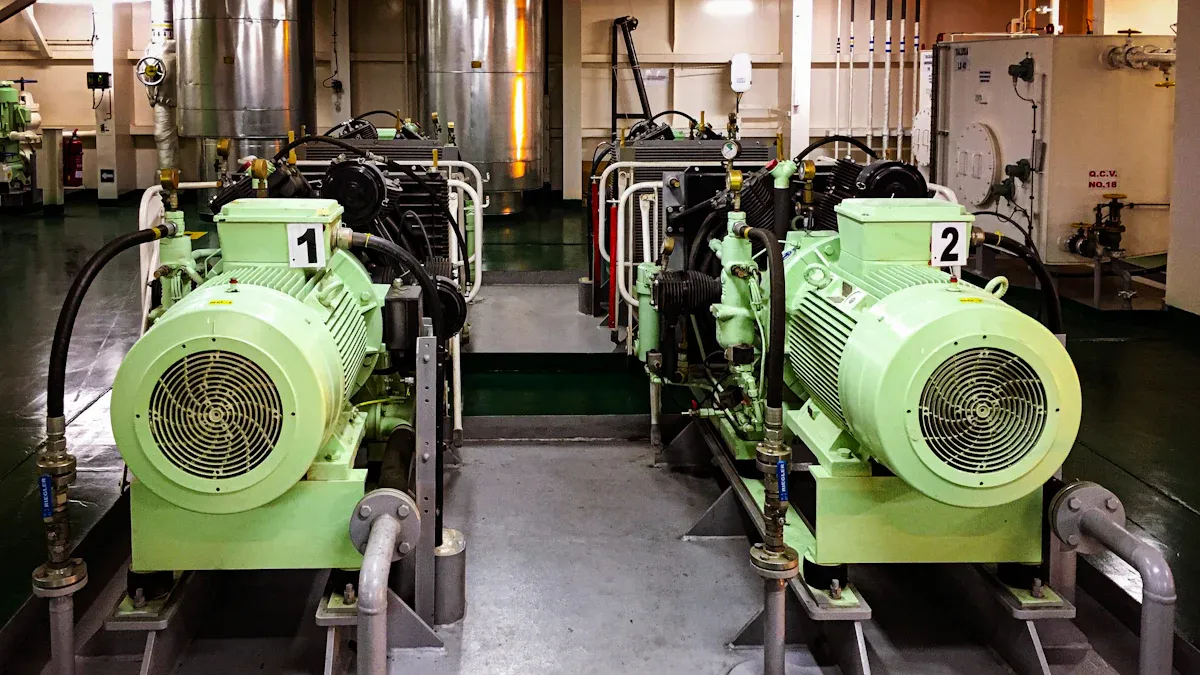
When I select a data center diesel generator, I always prioritize a four-stroke, water-cooled engine. This design delivers high performance and reliability, which are essential for continuous operation in a data centre. Water-cooled engines use a closed-loop coolant system to manage heat efficiently, even under sustained loads. I have found that this approach results in higher power density, longer service life, and lower thermal stress. The reduced noise output is another key advantage, especially in environments where quiet operation is critical. These benefits make water-cooled engines the preferred choice for data center applications.
I also look for additional features that enhance reliability and safety. I choose engines with automatic shutdown systems to prevent catastrophic failures. Weatherproof enclosures protect the engine from harsh environmental conditions, extending its lifespan. Remote monitoring systems give me real-time insights into engine performance and help me schedule preventive maintenance before issues arise.
- Automatic shutdown systems prevent catastrophic failures and enhance safety.
- Weatherproof enclosures protect against environmental factors, extending lifespan and reliability.
- Remote monitoring systems enable real-time performance insights and preventive maintenance.
Common Rail Injection
I always insist on common rail injection technology for my diesel generators. This system maintains high fuel pressure, which helps homogenize the fuel and air mixture. As a result, I see a 20% reduction in fuel emissions and a 5% improvement in efficiency. High-pressure injection allows for finer vaporization of fuel, leading to more complete combustion. Multiple injection events help manage engine noise and improve aftertreatment system performance. I have noticed that these features not only boost efficiency but also support compliance with strict environmental standards.
- The system maintains high pressure, homogenizing the fuel and air mixture.
- I achieve a 20% reduction in fuel emissions and a 5% increase in efficiency.
- High-pressure injection enables finer vaporization and more complete combustion.
- Multiple injection events help manage engine noise and improve aftertreatment performance.
Transient Response
Load Acceptance
I know that rapid load acceptance is critical for any data center diesel generator. The engine must handle sudden changes in load without significant drops in voltage or frequency. I rely on engines that can accept large load steps, such as the inrush from UPS systems, while maintaining stable operation. This capability ensures that sensitive IT equipment remains protected during power transitions.
The transient response requirements for diesel generators in data centers are defined by performance classes in ISO 8528-5. These standards focus on how well the generator accepts and rejects load. I measure these requirements based on the engine’s Brake Mean Effective Pressure (BMEP) and the size of the load steps. For example, the transient frequency deviation for load rejection is tested by simulating a sudden 100% power decrease, such as when a breaker opens unexpectedly.
- ISO 8528-5 defines transient response requirements, focusing on load acceptance and rejection.
- I measure performance using load steps and BMEP.
- Transient frequency deviation is tested with a 100% sudden power decrease.
ISO 8528-5 G3 Compliance
I always verify that my generator sets meet ISO 8528-5 G3 compliance. This standard sets strict criteria for voltage and frequency regulation, transient response, and harmonic distortion. I use the following table to check compliance:
| Criteria | Requirement |
|---|---|
| Voltage Regulation | Must maintain voltage within ±1% of the rated value during stable operation. |
| Frequency Regulation | Must maintain frequency within ±0.25% at steady state. |
| Transient Response | Must recover voltage and frequency within strict limits after load changes. |
| Harmonic Distortion | Total harmonic distortion (THD) must be within acceptable limits. |
| Load Acceptance and Recovery | Must accept large load steps without significant voltage or frequency drop. |
Meeting these requirements ensures that my data centre maintains stable and reliable power, even during rapid load changes.
Alternator Features
PMG Excitation
I always specify alternators with Permanent Magnet Generator (PMG) excitation for my data center diesel generator projects. PMG excitation provides reliable excitation power to the voltage regulator, especially during sudden load changes or faults. This feature ensures that the alternator can deliver sustained short-circuit current during fault conditions, preventing excitation collapse and maintaining reliability. Non-linear loads, which are common in data centers, do not affect the ability to provide power to the exciter. I also benefit from powerful voltage buildup at startup, which ensures quick recovery of voltage and torque for motors. PMG excitation isolates the AVR power source from disturbances, protecting sensitive equipment.
Harmonic Control
I pay close attention to harmonic control in alternator selection. A high-quality Automatic Voltage Regulation (AVR) card keeps voltage variations minimal, often below 0.5%. Well-designed windings reduce harmonic distortion and minimize interference with telecommunications systems. This is especially important in data centers, where non-linear loads from UPS systems and IT equipment can create significant harmonic currents. By choosing alternators with robust harmonic control, I ensure smooth power generation with stable voltage and frequency, protecting sensitive equipment and maintaining overall system efficiency.
| Benefit Description | Impact on Data Centers |
|---|---|
| Sustained short circuit current during faults | Prevents excitation collapse, ensuring reliability. |
| Non-linear loads do not affect the excitation field | Maintains power quality under varying load conditions. |
| Powerful voltage buildup at startup without relying on residual magnetism | Ensures quick recovery of voltage and torque for motors. |
| Isolation from high transient conditions during motor starting | Protects AVR functionality, enhancing performance. |
I have seen firsthand how these alternator features contribute to the efficiency and reliability of data center diesel generator systems. They help me deliver stable, high-quality power to critical infrastructure, ensuring uninterrupted operation for my clients.
Insulation & Temperature
Class H Insulation
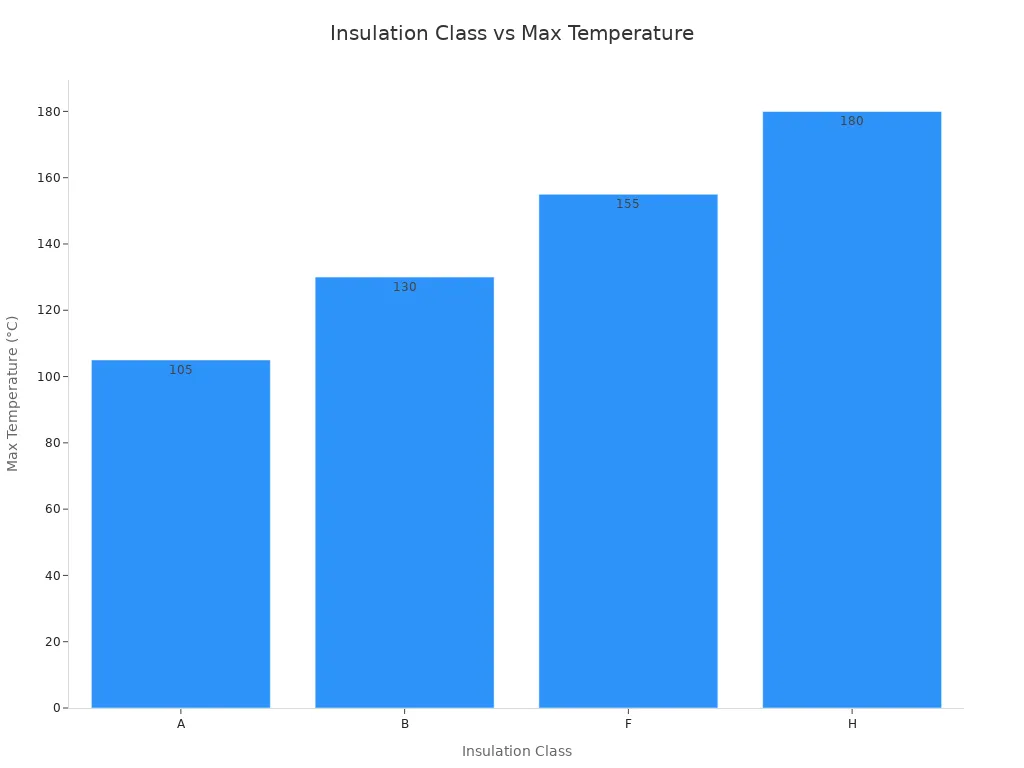
I always pay close attention to the insulation class when I select alternators for data center diesel generators. Insulation class determines how well the alternator can withstand high temperatures during continuous operation. I rely on Class H insulation because it offers the highest thermal endurance, rated for up to 180°C. This level of protection ensures that the alternator can handle demanding workloads without risk of premature failure. I know that the durability of an alternator depends on design parameters governed by NEMA MG 1 standards. These standards specify insulation class and temperature rise capabilities, which are critical for long-term reliability.
I often compare insulation classes to understand their differences. Class H insulation uses advanced materials like silicone and ceramic, which resist heat and aging better than traditional options. Lower classes, such as A or B, rely on materials like cotton, paper, or fiberglass, which cannot match the performance of Class H. I use the following table to illustrate the insulation classes and their maximum temperature ratings:
| Insulation Class | Max Temperature (°C) | Typical Materials |
|---|---|---|
| A | 105 | Cotton, Paper, Varnish |
| B | 130 | Fiberglass, Mica |
| F | 155 | Polyester, Epoxy Resins |
| H | 180 | Silicone, Ceramic |
I always choose Class H insulation for data center applications because it provides the best protection against thermal stress and extends the life of the alternator.
Thermal Margin
I focus on thermal margin to ensure stable operation and maximize efficiency. Thermal margin refers to the difference between the insulation class limit and the actual temperature rise during full-load operation. I prefer alternators that operate at Class F temperature rise (≤105°C) but use Class H insulation. This approach creates a safety buffer, reducing the risk of overheating and insulation degradation. I have seen that maintaining a healthy thermal margin improves efficiency and reliability, especially in environments with high ambient temperatures.
I use thermal margin as a key metric when evaluating alternator performance. I check that the alternator can sustain continuous operation without exceeding safe temperature limits. I also review cooling system design and airflow to support optimal heat dissipation. I find that alternators with a strong thermal margin deliver consistent performance and require less maintenance over time.
- I always select alternators with Class H insulation and a generous thermal margin for data center diesel generators.
- This combination ensures long-term durability, stable operation, and high efficiency under demanding conditions.
Tip: I recommend verifying insulation class and thermal margin during the procurement process to guarantee compliance with industry standards and protect critical infrastructure.
Fuel System & Storage
When I design a data center diesel generator system, I know that the fuel system is just as critical as the engine itself. A reliable power supply depends on careful planning for both main and daily service tanks. I always follow best practices to ensure continuous operation and compliance with Tier III and Tier IV standards.
Main Tank Sizing
Capacity Calculation
I start by determining the correct size for the main fuel tank. I calculate the generator’s hourly fuel consumption, define the required operation time, and add a safety margin. I use this formula:
Tank Volume (L) = Hourly Consumption (L/h) × Desired Operation Hours × (1 + Safety Margin)
For example, if my generator uses 200 liters per hour and I want 24 hours of autonomy with a 15% safety margin, I multiply 200 × 24 × 1.15, which equals 5,520 liters. This approach ensures that the generator can run without interruption during emergencies.
I always recommend these main tank sizing practices:
- Maintain 12–24 hours of autonomy per generator.
- Rotate and polish fuel every 3–6 months to prevent degradation.
- Use double-wall tanks or bunded containment for environmental safety.
- Test automatic transfer systems regularly to confirm readiness.
Tier III/IV Requirements
Meeting Tier III and Tier IV requirements means I must plan for redundancy and extended runtime. I make sure each generator has its own tank, sized for at least 24 hours of operation. In mission-critical facilities, I sometimes increase storage to 48 or even 72 hours, especially in areas with higher seismic risk. I comply with standards like NFPA 110 and UL 2085, which guide fuel storage for emergency power systems.
I always design with future growth in mind. I calculate the load (N) carefully and choose redundancy models such as N+1 or 2N. This commitment to redundancy prevents downtime and supports a reliable power supply for the data centre.
Daily Service Tank
Refilling Logic
I manage daily service tanks with strict procedures. I buy quality fuel from trusted suppliers to ensure stability. I check for water in the tank daily and drain any water found. I keep tanks full to minimize condensation and corrosion. I use recirculating filter systems to remove sediment and gums, and I clean tanks at least once every ten years. I avoid biodiesel because it has a shorter storage life and lower energy content.
Dual Supply Paths
For Tier IV data centers, I implement dual physically independent fuel supply paths. Each path has separate pumps, piping, and filtration. This design ensures that a single failure will not disrupt the emergency power systems. LETON POWER recommends dual-tank redundancy for large installations, which I find essential for maintaining efficiency and reliability.
Tip: I always test refilling logic and dual supply paths during commissioning to guarantee seamless operation during real emergencies.
Redundancy & Reliability
Tier III vs Tier IV
System Architecture
I always evaluate system architecture when designing a data center generator setup. Tier III and Tier IV facilities require different approaches to redundancy. Tier III uses an N+1 model, which means I add one extra generator to cover failures. Tier IV doubles the need, using a 2N model for maximum protection. I rely on this structure to ensure the power supply remains uninterrupted, even during maintenance or unexpected failures.
Here is a comparison table that helps me decide which architecture fits the project:
| Feature | Tier III | Tier IV |
|---|---|---|
| Redundancy | N+1 | 2N |
| Maintenance | Concurrently maintainable | Fault tolerant |
| System Behavior During Failures | Can maintain operations with one component down | Absorbs failures without impacting IT load |
| Complexity | Lower complexity | Higher complexity |
I find that Tier III allows me to maintain any single component without affecting IT operations. Tier IV absorbs failures without impacting the IT load, but it requires more complex systems.
Generator Redundancy
I always prioritize generator redundancy in my designs. I select configurations that match the facility’s tier level. For Tier III, I use N+1 redundancy, which lets me perform maintenance without risking downtime. For Tier IV, I implement 2N redundancy, so every generator has a backup. This approach ensures that the power supply remains stable and reliable. Redundancy is the foundation of data center reliability.
Maintenance & Service
Response Time
I know that fast response time is essential for maintaining generator reliability. I set up a 24/7 technical hotline and ensure on-site personnel can respond within two hours. I follow NFPA 110 guidelines, which require weekly operational checks and monthly runtime tests. I monitor fuel levels, battery charge, and coolant temperatures daily. I assess belt tension, air filters, and control panel logs weekly. I test transfer switches and validate auto-start sequences monthly.
Spare Parts
I keep a local warehouse stocked with critical spare parts. I store ECU boards, PMG regulators, injectors, pumps, filters, and sensors for at least two to three years of operation. I use remote diagnostics and condition monitoring to track generator health. Research shows that biannual oil and filter changes reduce unexpected shutdowns. I schedule preventive maintenance more frequently than annual intervals to maximize reliability.
| Frequency | Maintenance Tasks |
|---|---|
| Daily | Monitor fuel levels, battery charge, and coolant temperatures |
| Weekly | Assess belt tension, air filters, and control panel logs |
| Monthly | Test transfer switches, validate auto-start sequences, and clean fuel injectors |
Reliability Metrics
MTBF
I measure reliability using Mean Time Between Failures (MTBF). I track operating hours and record all incidents. High MTBF values indicate strong redundancy and robust maintenance practices. I aim for a minimum of 25,000 operating hours between overhauls. I use MTBF to evaluate generator performance and identify areas for improvement.
Lifecycle Management
I manage the lifecycle of each generator with a structured plan. I schedule regular maintenance, monitor performance, and replace parts proactively. I use digital monitoring systems to track runtime and efficiency. I plan for upgrades and expansion, ensuring the power supply meets future demands. Lifecycle management helps me maintain reliability and optimize operational costs.
Tip: I recommend reviewing redundancy architecture and maintenance schedules annually to ensure compliance and maximize reliability.
Control & Integration
When I design a data center generator system, I focus on advanced control and seamless integration. These features ensure that the facility maintains a reliable power supply, even during unexpected events. LETON POWER’s digital control solutions help me achieve high levels of redundancy and system flexibility.
Paralleling Logic
Isochronous Load Sharing
I rely on isochronous load sharing to balance real and reactive power across multiple generators. This method keeps all units running at the same frequency and voltage, which prevents overloads and supports redundancy. LETON POWER’s controllers automatically adjust each generator’s output, so the system responds quickly to changes in demand. This approach maintains stable operation and protects sensitive equipment.
Random Paralleling
Random paralleling gives me the flexibility to bring generators online in any order. The first generator to reach the correct voltage and frequency connects to the bus, and the others synchronize automatically. This feature reduces response time during emergencies and supports true multi-master redundancy. I can integrate different brands of generators, which increases system versatility and simplifies upgrades.
| Key Feature | Description |
|---|---|
| Advanced Generator Protection | Ensures reliable operation and safeguards infrastructure from faults. |
| Seamless Integration | Allows for the export of surplus power while prioritizing data center loads. |
| Support for Critical Power Continuity | Maintains power supply during outages, ensuring uninterrupted service for data centers. |
| Ancillary Services | Provides additional support functions that enhance overall system reliability and efficiency. |
| True Multi-Master Redundancy | Increases flexibility and reliability in generator control systems. |
| Brand-Agnostic Integration | Facilitates compatibility with various generator brands, enhancing system versatility. |
| Centralized Control | Aids in troubleshooting by allowing operators to monitor and manage systems from a central location. |
Load Shedding
Intelligent Control
I use intelligent load shedding to protect emergency power systems and maintain performance. The system scans for disturbances and sheds non-critical loads before the generators become overloaded. This proactive approach reduces mechanical stress and extends equipment life. Intelligent controllers group loads by priority, so essential systems always receive power during peak demand.
- Intelligent load shedding provides fast, automated control of loads.
- Proactive management anticipates disturbances and prevents generator overload.
- Multi-threading technology determines the optimal amount of load to shed instantly.
- Load grouping separates essential from non-essential loads for better prioritization.
- Automatic transfer and shedding systems adjust non-critical loads to ensure safe operation.
BMS Integration
I integrate generator controls with the building management system (BMS) for centralized monitoring and control. LETON POWER’s digital solutions support protocols like BACnet and SNMP, which allow seamless data exchange. This integration lets me view alarms, trends, and generator status in real time. I can automate load transfers and coordinate with other facility systems, improving redundancy and operational efficiency.
Monitoring Interfaces
Remote Diagnostics
Remote diagnostics give me instant visibility into generator health. I monitor turbines, engines, and switchgear from any location. Secure cloud access provides real-time data, including alarms and fault codes. I use dashboard interfaces to review test history, runtime logs, and performance trends. This capability helps me respond quickly to issues and maintain a reliable power supply.
Secure Access
I prioritize secure access to all monitoring systems. LETON POWER’s solutions use encrypted communication over cellular, Ethernet, or satellite links. Virtual HMIs display complete fault codes with text descriptions, making troubleshooting easier. I can start or stop generators remotely and collect data for analysis. Cloud services offer secure data logging and REST API access for external connections.
| Feature | Description |
|---|---|
| Secure Cloud Access | Provides secure, cloud-based access to real-time equipment performance. |
| Remote Monitoring | Enables reliable monitoring of turbines, engines, and switchgear from any location. |
| Instant Visibility | Offers access to alarms, trends, and health indicators for faster diagnostics. |
| Data Collection | Sends generator data to BMS via BACnet UDP or SNMP. |
| Remote Start/Stop Functionality | Allows remote operation of generators when needed. |
| Virtual HMIs | Delivers instant data and complete fault code support with clear descriptions. |
| Communication Devices | Uses cellular, Ethernet, and satellite devices for secure remote access. |
| Dashboard Interfaces | Shows generator status, test history, runtime logs, and alarms in real time. |
| Cloud Services | Provides secure data logging and REST API access for external systems. |
Tip: I always test remote diagnostics and secure access features during commissioning to ensure full system visibility and fast response in emergencies.
By combining advanced control, intelligent load management, and robust monitoring, I create generator systems that deliver high performance and unmatched redundancy. LETON POWER’s digital integration ensures my data center always has a reliable power supply, no matter the challenge.
Physical & Environmental Needs
Installation & Footprint
Space Planning
When I plan a generator installation, I always start with a thorough assessment of the site. I look at the total power load, future expansion, and how the generator will integrate with existing systems. I use a table to organize my considerations:
| Key Consideration | Description |
|---|---|
| Capacity and Load Assessment | I assess current and future power needs to prevent operational issues. |
| Location and Space Requirements | I choose locations with enough space for equipment, personnel, and ventilation. |
| Fuel Type and Storage | I ensure safe, compliant diesel storage for extended operation. |
| Compliance with Regulations | I follow all local and national codes, including noise and environmental standards. |
| Maintenance and Testing | I provide clear access for regular inspections and load testing. |
| Planning for Future Expansion | I leave room for additional capacity to avoid costly changes later. |
| Integration with Existing Systems | I make sure the generator connects smoothly to backup power infrastructure. |
Accessibility
I always design layouts that allow easy access for maintenance and emergency response. I keep clear walkways around the generator and fuel tanks. I make sure doors and hatches open fully. I also plan for equipment delivery and removal, which helps reduce downtime during upgrades or repairs.
Cooling & Ventilation
Remote Radiator
I often specify remote radiators for large generator rooms. This setup moves heat outside the main equipment area, reducing the risk of overheating. LETON POWER’s remote radiator solutions help me keep the generator room cooler and quieter. I use variable-speed fans to match cooling needs and save energy.
Airflow & Heat Dissipation
I focus on airflow management to remove heat efficiently. I follow these best practices:
- I direct ventilation air to enter low and flow over the generator, cooling key components.
- I use evaporative cooling when outside temperatures rise, which keeps the room comfortable.
- I check that fan static pressure stays within limits to maintain airflow.
- I keep room temperatures above freezing to ensure reliable starts in cold weather.
These steps help me maintain stable operation and extend equipment life.
Noise & Vibration
Acoustic Enclosures
I always address noise control early in the design. I use acoustic enclosures with high-density sound-absorbing panels. I seal all doors and maintenance hatches to prevent sound leaks. LETON POWER’s noise control schemes help me meet strict environmental standards, keeping noise below 85 dB(A) inside and 65 dB(A) outside the generator room.
Vibration Isolation
I install high-performance vibration isolation systems under the engine and base. I use multi-stage industrial silencers and composite structures to absorb sound. I design concrete foundations to prevent vibration from spreading through the building. These measures protect sensitive equipment and create a safer environment for staff.
Tip: I always test noise and vibration levels after installation to confirm compliance with project requirements.
I find that careful planning of installation, cooling, and noise control ensures reliable and efficient operation in any data centre.
High-Voltage Switchgear & Grounding
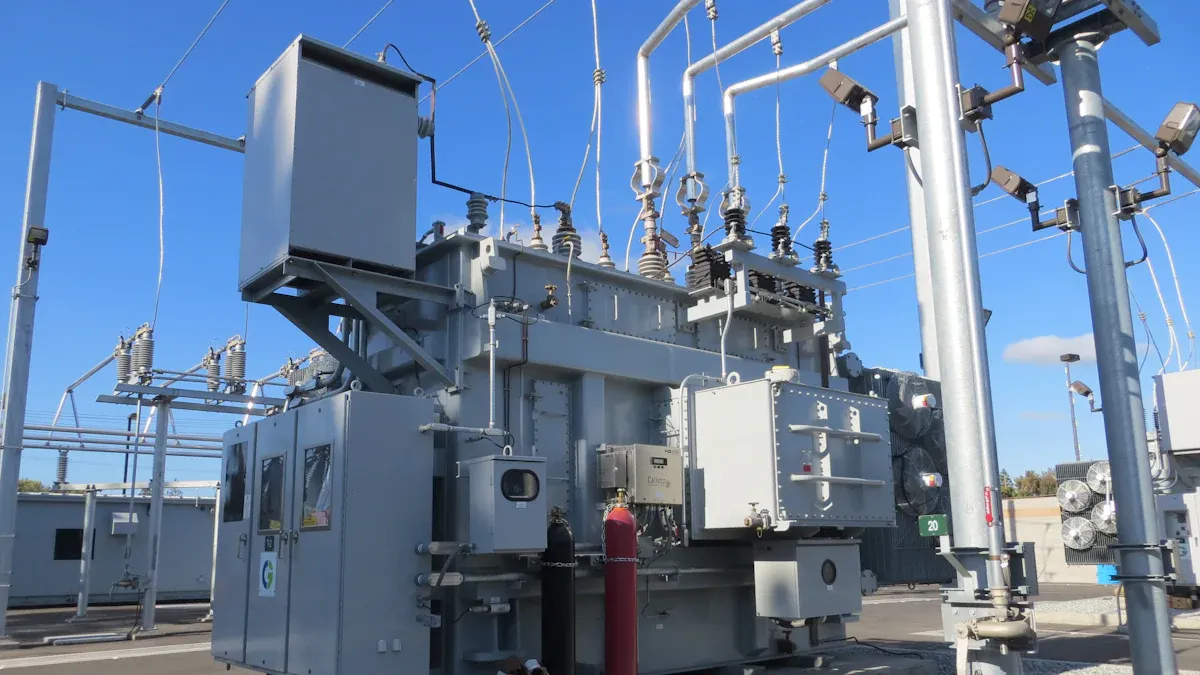
When I design power systems for data centers, I always pay close attention to the high-voltage switchgear and grounding methods. These components play a critical role in ensuring safe, reliable, and efficient operation. LETON POWER provides advanced solutions that meet the demanding requirements of modern data centers.
10.5kV Switchgear
Direct Medium Voltage
I prefer using 10.5kV generator sets for large-scale data centers. This approach allows me to connect directly to the medium-voltage distribution system. By doing so, I eliminate the need for step-up transformers, which reduces energy losses and simplifies the overall cabling. LETON POWER’s 10.5kV switchgear supports seamless integration with multiple generator sets operating in parallel. I find this especially valuable for hyperscale facilities where long cable runs and high current demands are common.
Circuit Breaker & Protection
I always select switchgear that meets strict technical specifications. The right choice ensures safe operation and protects both equipment and personnel. Here is a summary of the key specifications I look for:
| Specification | Value |
|---|---|
| Rated voltage | 3.3–13.8 kV |
| Rated frequency | 50/60 Hz |
| Rated current of circuit breaker | 630, 1250, 1600, 2000, 2500, 3150 A |
| Rated current of switchgear | 630, 1250, 1600, 2000, 2500, 3150 A |
| Rated current of main bus | 1250, 1600, 2000, 2500, 3150, 4000 kA |
| Rated peak withstand current (peak) | 40, 50, 63, 80, 100, 125 kA |
| Rated short-circuit breaking current | 16, 20, 25, 31.5, 40, 50 kA |
| Rated short-circuit making current | 40, 50, 63, 80, 100, 125 kA |
I always verify that the circuit breakers are vacuum type with robust mechanical interlocks. LETON POWER recommends using multifunction microprocessor relays for protection, including differential, overcurrent, and earth fault detection. These features help me maintain system stability and quickly isolate faults.
Grounding System
HRG Method
I rely on High Resistance Grounding (HRG) for data center diesel generator installations. HRG offers several advantages over solidly grounded systems. It allows continued operation during a ground fault, which is essential for critical facilities like data centers. HRG minimizes the risk of severe arc flash hazards and equipment damage. I can identify and repair faults without shutting down the entire system, which keeps power flowing to vital IT loads. LETON POWER recommends HRG as a best practice for safety and reliability in medium-voltage applications.
Note: HRG systems significantly reduce fault currents and enhance personnel safety. I always consider HRG during the design phase to ensure long-term protection and operational continuity.
Fault Detection
I use advanced ground fault detection relays with zero-sequence current transformers. These devices provide immediate alarms when a ground fault occurs. I can quickly locate and address the issue before it escalates. LETON POWER’s grounding solutions include temperature-monitored resistor cabinets and forced-air cooling for added safety. I always test the system during commissioning to confirm that all alarms and protections work as intended.
- HRG enables safe, continuous operation during faults.
- Quick fault identification protects both people and equipment.
- LETON POWER’s recommendations help me achieve the highest standards of reliability.
By focusing on robust switchgear and grounding systems, I ensure my data center projects deliver safe, efficient, and uninterrupted power.
I always prioritize technical specifications when I select a data center diesel generator. I review power capacity, total power load, and compliance with environmental regulations. I trust LETON POWER to deliver reliable solutions for every data centre project. I recommend using these guidelines to ensure continuous operation and future-proof your infrastructure.
FAQ
What is the DCC rating, and why do I need it for my data center?
I choose the DCC (Data Center Continuous) rating because it certifies that my generator can run at 100% load for unlimited hours. This rating ensures compliance with Tier III and Tier IV standards and supports continuous, reliable operation.
How do I calculate the right generator size for my facility?
I start by listing all critical loads, then add future growth and redundancy needs. I use manufacturer sizing tools and consider derating for altitude and temperature. This approach helps me select the correct generator size for my data center.
Why should I use PMG excitation in alternators?
I use PMG excitation because it provides stable voltage regulation, especially during sudden load changes. This feature protects sensitive IT equipment and ensures reliable power quality, even with non-linear loads common in data centers.
How often should I perform maintenance on my diesel generator?
I follow a strict schedule: daily checks for fuel and coolant, weekly inspections, and monthly tests of transfer switches. I also schedule preventive maintenance every six months to maximize reliability and reduce the risk of unexpected failures.
What is High Resistance Grounding (HRG), and how does it benefit my data center?
I use HRG to limit ground fault currents. This method allows my data center to keep running during a single ground fault. HRG reduces arc flash risks and makes it easier to locate and fix faults without shutting down the system.
How do I ensure my generator system meets Tier IV requirements?
I design for 2N redundancy, dual fuel supply paths, and independent cooling systems. I verify all components meet Tier IV standards. I test the system under real-world conditions to confirm fault tolerance and continuous operation.
Can I monitor and control my generators remotely?
Yes, I use LETON POWER’s digital control solutions. These systems let me monitor generator status, receive alarms, and start or stop units from anywhere. Secure cloud access and integration with BMS make remote management simple and effective.
What steps do I take to control noise and vibration in the generator room?
I install acoustic enclosures, high-performance silencers, and vibration isolators. I test noise levels after installation. LETON POWER’s solutions help me meet strict noise standards and protect both staff and sensitive equipment.

