
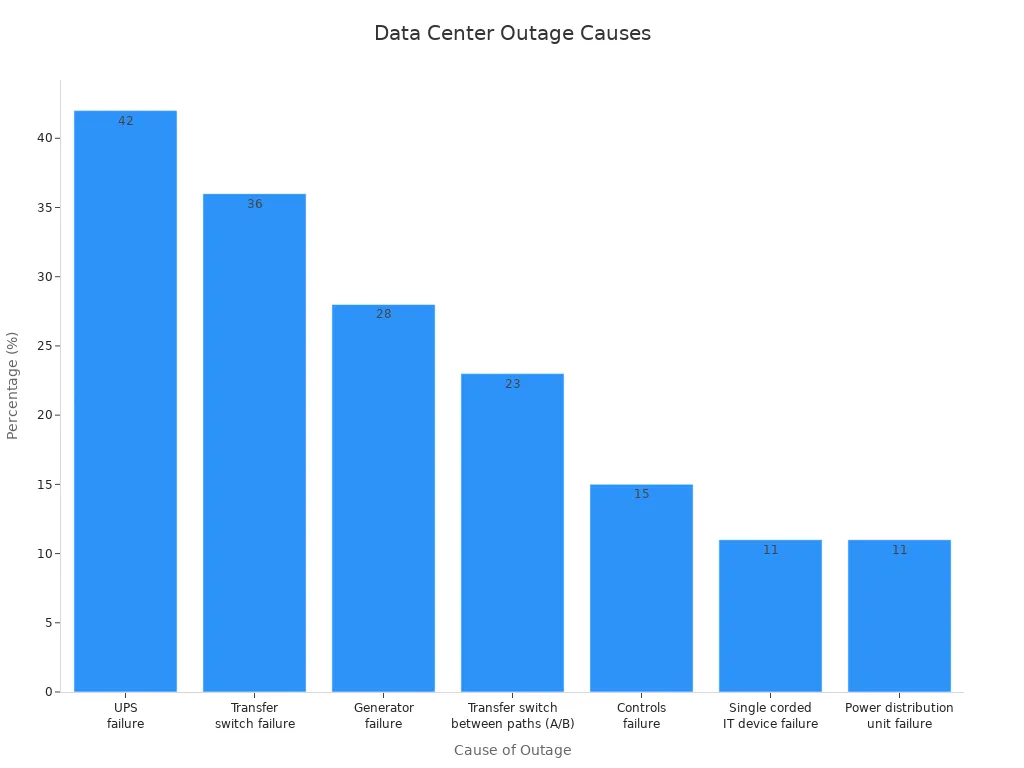
I know that power reliability stands at the heart of every modern data center. As I watch hyperscale, AI, and edge infrastructure reshape the industry, I see power demands grow and the risks of downtime increase. For me, zero downtime is not just a goal—it is a necessity. I rely on robust generator solutions to safeguard your power supply and maintain data center generator uptime. Generator failures account for 28% of outages, as shown below:
| Cause of Outage | Percentage |
|---|---|
| UPS failure | 42% |
| Transfer switch failure | 36% |
| Generator failure | 28% |
| Transfer switch between paths (A/B) | 23% |
| Controls failure | 15% |
| Single corded IT device failure | 11% |
| Power distribution unit failure | 11% |
- AI workloads need high-density computing and advanced cooling.
- Edge computing makes power availability critical for site selection.
- Infrastructure upgrades and new cooling technologies are essential.
- Power accessibility now shapes how I plan edge data centers.
I focus on practical strategies to reduce downtime and keep operations running smoothly.
Key Takeaways
- Prioritize preventive maintenance to catch issues early and ensure generator reliability.
- Invest in advanced monitoring systems to detect problems before they lead to outages.
- Train your staff regularly on emergency procedures to improve response times during power failures.
- Choose the right redundancy model (N+1 or 2N) based on your risk tolerance and operational needs.
- Regularly test your backup systems to verify performance and readiness for real-world demands.
- Stay informed about regulatory standards to ensure compliance and avoid costly penalties.
- Utilize remote monitoring and predictive analytics to enhance maintenance strategies and reduce downtime.
- Plan for future energy demands by integrating renewable energy solutions and smart microgrids.
Data Center Generator Uptime: Why It Matters
Business Continuity Impact
I know that data center generator uptime forms the backbone of my operations. When I lose power, the consequences can be immediate and severe. I have seen how even a short outage can disrupt my services and damage my reputation. Here are the most common issues I face when generator uptime is compromised:
- Data loss can occur if power disruptions corrupt important files or databases.
- Service disruptions may make my websites and applications unavailable to users.
- Financial losses often follow downtime, as I lose revenue and risk damaging my brand.
I always include generator reliability in my business continuity plan. This approach helps me protect my data, maintain customer trust, and keep my operations running smoothly.
Financial and Compliance Risks
I understand that data center generator uptime does more than keep the lights on. It shields me from costly financial and regulatory risks. In regulated industries, I must meet strict uptime requirements. If I fail, I could face serious consequences. The table below shows the main compliance risks I consider:
| Compliance Risks | Description |
|---|---|
| Failed audits | Inadequate generator uptime can lead to audits failing due to non-compliance. |
| Potential fines | Regulatory bodies may impose fines for non-compliance with uptime requirements. |
| Risk to licensure | Industries may risk losing their licenses if they fail to maintain adequate generator uptime. |
| Exposure to liability | Companies may face legal liabilities due to operational failures linked to generator issues. |
I know that a single outage can trigger failed audits or even legal action. I invest in reliable generator systems to avoid these risks and protect my bottom line.
Evolving Demands in 2026
I see the demands on data center generator uptime growing every year. In 2026, I expect new challenges to emerge:
- Electricity demand will rise sharply as AI workloads expand. This growth may outpace the current power grid.
- The U.S. Department of Energy predicts that data center electricity use could nearly triple by 2028, jumping from 176 TWh in 2023 to between 325 and 580 TWh.
- AI workloads may account for up to half of all data center capacity by 2030, compared to about a quarter today.
I must prepare for these changes by investing in advanced generator solutions. I focus on systems that can scale with my needs and support continuous uptime. This strategy ensures I stay ahead of industry trends and keep my data center resilient.
Key Causes of Power Outage and Generator Failure
Mechanical and Electrical Issues
I have learned that most generator failures in data centers come from mechanical and electrical problems. These issues can stop my backup systems from working when I need them most. Here is a table that shows the most common causes and their impact:
| Cause | Description |
|---|---|
| Fuel Contamination | Water, dirt, or microbes in fuel can damage pumps and lower efficiency. |
| Battery Failure | Dead batteries or corroded terminals can stop the generator from starting. |
| Control Panel and ATS Faults | Faulty sensors or misconfigurations can cause failure during power transfer. |
| Cooling System Problems | Low coolant or blocked radiators can lead to overheating and shutdowns. |
| Lubrication Issues | Poor lubrication can damage the engine and reduce performance. |
| Electrical Faults | Loose connections or damaged wiring can prevent power delivery. |
| Mechanical Failures | Worn parts can cause vibrations and further damage. |
| Leaks in Critical Systems | Oil, fuel, or coolant leaks can increase fire risk and reduce lubrication. |
I rely on LETON POWER’s advanced alternators to handle the nonlinear loads from my UPS systems and servers. Their redundant starting systems, like dual-electric or hydraulic starters, give me confidence that my generators will start every time. These features help me avoid unexpected downtime and keep my data center running.
Human Error
I know that even the best equipment can fail if my team does not follow the right steps. In 2025, 58% of outages linked to human error happened because staff did not follow established procedures. This number rose from 48% the year before. I also see that 45% of outages came from incorrect staff processes. To reduce these risks, I make sure my team receives regular training and follows clear checklists. I use LETON POWER’s intelligent control systems, which log every event and help my staff spot problems before they cause a power outage.
Tip: I always encourage my team to double-check their work and report any unusual system behavior right away.
Environmental Factors
I have seen how outside forces can threaten my generator uptime. The table below lists the most common environmental factors that can lead to generator failure:
| Environmental Factor | Description |
|---|---|
| On-site power failure | Problems in power distribution can cause outages and affect my backup systems. |
| Natural disasters | Hurricanes or earthquakes can disrupt operations and delay fuel deliveries. |
| Equipment failure | Continuous use wears down parts, raising the risk of failure. |
| Human error | Mistakes in maintenance or configuration can increase the chance of a power outage. |
| Cybersecurity threats | Cyberattacks can disrupt power and increase blackout risks. |
I protect my data center by choosing robust, containerized solutions from LETON POWER. Their fire-rated enclosures and remote monitoring help me spot threats early and respond quickly. I also plan for natural disasters and invest in cybersecurity to keep my power systems safe.
Selecting Generators for Maximum Uptime
Sizing and Capacity
I always start with sizing and capacity when I select a backup generator for my data center. I know that proper capacity planning is essential for uptime. If I choose a generator that is too small, I risk system failures during outages. If I oversize, I waste resources and lower efficiency. I assess my current power needs and plan for future growth. This approach helps me ensure that my backup power system can handle unexpected load surges and keep my operations running.
I use a table to guide my selection process:
| Criteria | Description |
|---|---|
| Type of generator system required | I consider the location, operational needs, and load demand of my data center. |
| Equipment certifications | I check for certifications like UL and EPA for reliability. |
| Compliance with technical standards | I follow ISO 8528, NFPA 110, and local rules for safety and quality. |
| Generator type | I choose between prime, standby, or continuous based on my needs and expected outages. |
| Size of generator | I match the generator size to my power requirements and future growth. |
| Fuel source | I ensure the fuel source is available and can support long outages. |
I rely on LETON POWER’s G3-standard design for high performance and reliability. Their generators support both current and future needs, which gives me confidence in my backup power strategy.
Standards and Compliance
I know that meeting standards and compliance requirements is not optional. It is a must for data center operators like me. I check for the latest regulations before I select a backup generator. I look for compliance with ISO 8528 and NFPA 110. I also pay attention to local and federal emissions standards, such as U.S. EPA Tier 4.
Here is a summary of what I consider:
| Category | Requirement | Details |
|---|---|---|
| Mid-Range Units (500kW–1500kW) | Increased fault current ratings | I may need to update breaker and switchgear specs. |
| Large / Megawatt-Class Systems (1500kW+) | Grounding/fault current changes | I use dual neutral configurations and strong ground grids. |
| Emissions Standards | Compliance with U.S. EPA Tier 4 | I select generators that meet strict emissions rules. |
- Virginia may require 0.6 g/hp-hr NOX emissions for new diesel generators.
- Illinois will enforce EPA Tier 4 standards starting January 2026.
- Local agencies can set stricter rules than federal standards.
I choose LETON POWER generators because they meet these requirements and offer advanced emission controls. This helps me stay compliant and protect the environment.
Modular and Containerized Solutions
I prefer modular and containerized solutions for my data center. These options give me flexibility and speed. I can deploy backup power quickly, even in remote or challenging locations. Containerized sets from LETON POWER arrive fully assembled, which saves me time and reduces installation risks.
Here are the main benefits I see:
- Mobility and easy transportation for rapid deployment.
- Weatherproof enclosures that protect against harsh environments.
- Quick installation and operation, which is vital for time-sensitive projects.
- Scalability to add more units as my power needs grow.
- Noise reduction and enhanced safety for my staff and equipment.
I also value LETON POWER’s compatibility with sustainable fuels like HVO and their integration with smart microgrids and BESS. These features help me improve performance, reduce my carbon footprint, and support my long-term energy goals. I know that modular sets and rapid delivery keep my data center ready for any challenge. I always focus on performance, reliability, and the critical components that keep my backup generator system strong.
Uninterruptible Power Supply and UPS Systems Integration
UPS-Generator Coordination
I always treat the integration of ups systems and generators as a top priority in my data center. When I combine these systems, I create a seamless bridge between utility power and backup supply. This approach keeps my critical equipment running, even during unexpected outages. I rely on ups systems to provide an immediate supply of power. They fill the gap before my generators start and take over for longer outages. This coordination prevents interruptions and protects my operations.
I follow several best practices to ensure smooth ups-generator coordination:
- I schedule power system deliveries to match installation dates.
- I make sure my teams are ready before equipment arrives.
- I use real-time tracking to monitor shipments and avoid delays.
I also focus on ups design. I select reliable units and build in redundancy. I integrate efficient power management to keep my systems running at peak performance. Regular maintenance and testing help me prevent failures and improve reliability.
A generator docking station gives me a secure and efficient way to connect temporary backup generators and load banks. This solution supports both power reliability and compliance during generator testing.
Battery Health and Load Management
I know that battery health is the backbone of my ups systems. I track battery health continuously to prevent unexpected failures. I set threshold alarms for each battery. These alarms notify me if any battery voltage moves outside the normal range. I use external monitoring systems for comprehensive oversight. This approach helps me safeguard my operations and keep my power systems reliable.
Proper load management is essential for ups systems. I monitor the load to prevent overcharging and ensure balanced supply. This practice extends battery life and keeps my systems ready for emergencies. I always include comprehensive ups inspections in my maintenance plan. These inspections help me spot issues early and keep my ups systems in top condition.
Here are the key benefits I see from battery health monitoring and proper load management:
- Enhanced reliability through continuous tracking.
- Proactive alerts that warn me of potential problems.
- Holistic oversight with external monitoring systems.
Functional Testing Protocols
I believe that regular testing is the foundation of reliable ups systems and generator integration. I use a range of functional testing protocols to verify that my systems work as expected. Maintenance and repair verification help me confirm that all components are in good condition. I test power sources to check performance and ensure standby power systems operate correctly.
I use the following table to organize my testing protocols:
| Testing Method | Description |
|---|---|
| UPS Startup | I confirm proper installation and perform initial checks, including infrared scanning and onsite tests. |
| UPS Battery Testing | I evaluate battery connections, cells, and capacity to ensure they meet system output needs. |
| Load-Bank Testing | I verify load carrying characteristics and check performance under controlled conditions. |
| Burn-In Testing | I extend load bank testing to find early failure points and assess overall system performance. |
| Routine Maintenance | I conduct ongoing testing and document results to predict repairs and maintain system performance. |
When I perform load-bank testing, I always ensure the load bank is properly rated for the generator. I disconnect other power sources before testing. I warm up the generator to prevent engine damage. I monitor performance during the test and stop if I notice any issues.
Regular load bank testing is crucial for generator reliability. Properly rated load banks prevent overloading. Disconnecting power sources keeps my team safe during tests.
I make functional testing a routine part of my maintenance schedule. This habit helps me catch problems early and keep my ups systems and generators ready for any emergency.
Essential Maintenance Tips for Generator Uptime

Preventive Maintenance Scheduling
I always treat preventive maintenance as the foundation of generator reliability in my data center. I follow a strict schedule to keep my systems ready for any emergency. I know that regular maintenance tasks help me catch small problems before they become big failures. I use a combination of weekly, monthly, semi-annual, and annual tasks to cover every part of my generator system.
- Weekly tasks include starting and running the generator with no load, checking for fluid leaks, confirming there are no alarms, and verifying fuel levels and circuit breakers.
- Monthly tasks involve inspecting the generator perimeter for debris, checking oil and coolant levels, and cleaning battery terminals while inspecting wiring for corrosion.
- Semi-annual tasks require a full battery diagnostic check and inspection of the exhaust system and air filters.
- Annual tasks include a visual inspection of the alternator, replacing air and fuel filters, and conducting load bank tests.
I have seen that following these essential maintenance tips restores the reliability of my power equipment up to 98.5%. I also reduce the risk of forced interruptions and extend the useful life of my generators up to 25 years. I always include scheduled preventive maintenance in my operational plan. I rely on LETON POWER’s lifecycle support and preventive maintenance programs to keep my systems running at peak performance. Their factory-trained professionals perform full-load testing and routine inspections, which gives me peace of mind.
Tip: I keep a detailed log of all maintenance activities. This record helps me track trends and plan future inspections more effectively.
Remote Monitoring and Predictive Analytics
I use remote monitoring and predictive analytics to take my maintenance strategy to the next level. These tools let me see real-time data from my generators, no matter where I am. I can spot early signs of wear or malfunction before they cause downtime. AI-powered systems analyze this data and give me early warnings about potential failures. This approach allows me to act quickly and avoid unplanned outages.
I have found that predictive maintenance helps me prevent downtime and improve efficiency. I receive alerts when something needs attention, so I can schedule repairs before a problem grows. This proactive approach enhances asset availability and keeps my data center running smoothly. LETON POWER’s remote monitoring platform integrates seamlessly with my operations. I access system status from my workstation or smartphone, which makes it easy to manage maintenance from anywhere.
- Early detection of issues prevents costly outages.
- Real-time analytics improve decision-making.
- Predictive protocols reduce operating costs and extend equipment life.
I always include remote monitoring and predictive analytics in my list of essential maintenance tips. These technologies help me stay ahead of problems and maintain high uptime.
Staff Training and Emergency Drills
I believe that well-trained staff are just as important as reliable equipment. I invest in regular training and emergency drills to make sure my team knows how to respond to any situation. I run mock drills that simulate power failures and other disruptions. These exercises help my staff practice emergency protocols and build confidence.
I cross-train my team on backup power systems and emergency procedures. I document the findings from each drill to improve our protocols. I also conduct annual drills to test the effectiveness of our emergency plan. This routine ensures everyone knows their role during a crisis.
- Regular training keeps my team prepared for unexpected events.
- Emergency drills reveal gaps in our response plan.
- Cross-training builds flexibility and resilience within my staff.
I always include staff training and emergency drills in my essential maintenance tips. LETON POWER supports my team with technical resources and training programs. Their experts help me develop best practices for routine inspections and emergency response.
Note: I encourage my staff to share feedback after each drill. Their insights help me refine our procedures and strengthen our overall maintenance strategy.
By following these essential maintenance tips, I maximize generator uptime and protect my data center from unexpected outages. I combine preventive scheduling, advanced monitoring, and skilled staff to create a robust maintenance program that delivers results.
Redundancy and Disaster Recovery Planning
N+1 and 2N Redundancy Models
I always prioritize redundancy when I design my data center’s power system. Redundancy means I have backup components ready to take over if something fails. This approach helps me meet Uptime Institute Tier III and Tier IV requirements, which demand high reliability. I often choose between N+1 and 2N redundancy models. Each model offers different levels of protection and complexity. I use the following table to compare them:
| Feature | N+1 Redundancy | 2N Redundancy |
|---|---|---|
| Failure Handling | Allows for a single failure | Can handle multiple failures |
| System Structure | Additional component for backup | Mirrored system for immediate takeover |
| Downtime Risk | Higher risk of downtime with multiple failures | Lower risk due to redundancy |
N+1 redundancy gives me one extra unit for backup. If one generator fails, the backup takes over. 2N redundancy means I have a complete mirror of my power system. This setup can handle more than one failure at a time. I choose the model that fits my risk tolerance and budget. Both models help me keep my data center running, even during unexpected events.
Automatic Transfer Switches
I rely on automatic transfer switches (ATS) to enhance my disaster recovery plan. ATS devices detect power outages and switch to backup generators within seconds. This quick response keeps my servers online and prevents costly downtime. I see several benefits from using ATS:
- ATS minimizes downtime by switching power sources almost instantly.
- It maintains power continuity, which is vital for real-time data processing.
- The fast response prevents operational disruptions during outages.
- ATS protects sensitive equipment from data loss.
- It automates the transfer process, so my team can focus on other tasks.
I know that ATS plays a key role in my redundancy strategy. It ensures that my backup systems activate without delay, which is essential for meeting strict uptime requirements.
Disaster Recovery and Contingency Plans
I treat disaster recovery planning as a core part of my operations. I follow a structured approach to prepare for power outage scenarios:
- I conduct a business impact analysis to identify risks and weak points.
- I tier my applications by criticality, so I know which systems to recover first.
- I back up my data regularly to minimize loss during disasters.
- I create automated runbooks that guide my team through recovery steps.
- I integrate technology recovery stacks and track recovery metrics for improvement.
I also communicate with local utilities and vendors to set up contingency plans. I keep written policies and procedures for disaster recovery. I test my plans often to make sure they work. Regular drills help my team respond quickly and confidently. By combining redundancy, ATS, and robust contingency plans, I protect my data center from unexpected outages and ensure continuous operation.
Future Trends in Data Center Power Solutions
Smart Microgrids and BESS
I see smart microgrids and battery energy storage systems (BESS) changing how I manage power in my data center. These systems let me use on-site renewable energy and store extra power for later. I can respond quickly to changes in demand and keep my operations running during grid outages. Microgrids also help me balance supply and demand, which supports grid stability and lowers my costs.
| Aspect | Description |
|---|---|
| Energy Prosumers | I use on-site renewables and storage to optimize energy production and consumption. |
| Resilience | My data center becomes more resilient against outages and power fluctuations. |
| Grid Stability | I help balance the grid by adjusting my energy use and storage. |
| Demand Response Participation | I join demand response programs to optimize energy use during peak times. |
Large-scale batteries store excess renewable energy, so I can use it when demand is high. I combine fast lithium-ion batteries with longer-duration solutions for backup power. This approach improves reliability and helps me reduce my carbon footprint.
Renewable Integration
I notice that renewable energy is now a core part of my power strategy. I use power purchase agreements and green tariffs to reach 100% renewable energy each year. Some data centers, including mine, explore heat batteries and other storage methods to store extra renewable power. This can turn my facility into a giant battery for the grid.
- I see the Data Center Flexible Load Initiative aiming to create flexibility hubs by 2027. These hubs will let me provide grid services and adjust my energy use as needed.
- I explore nuclear and geothermal options for reliable, carbon-free power.
- I invest in co-located developments that offset capital costs and bring long-term benefits.
| Evidence Description | Source |
|---|---|
| I use renewable energy through agreements and tariffs, reaching 100% renewable use annually. | RMI |
| I explore heat batteries and storage to transform my data center into a grid resource. | Brown Advisory |
| I finance co-located renewable projects for long-term gains. | RMI |
Regulatory and Industry Standards
I must keep up with new regulations and industry standards. I work closely with utilities to secure reliable power and explore on-site generation for both my needs and grid-level storage. Regulators now see data centers as major energy assets, so I face more scrutiny.
- Performance-based interconnection links my queue priority to real-time telemetry and flexibility.
- Resource adequacy rules may soon count my flexible load and batteries as reliable capacity.
- Dynamic tariffs expose me to real-time price signals, so I must manage my energy use carefully.
I also prioritize certifications like ISO/IEC 27001 and SOC 2 Type II to ensure compliance. Government policies may set power limits or offer incentives for green data centers. I stay informed about GDPR, CCPA, and HIPAA to protect data and privacy. These trends push me to innovate and adopt sustainable, reliable power solutions for the future.
I focus on these key steps to maximize generator uptime in my data center:
- I conduct routine battery maintenance.
- I use advanced monitoring and predictive analytics.
- I replace batteries below 80% capacity.
- I perform discharge testing.
- I maintain stable environmental conditions.
- I establish emergency procedures and checklists.
I review and update my maintenance and contingency plans regularly. The table below shows how often I schedule these tasks:
| Maintenance Task | Frequency |
|---|---|
| Battery and system checks | Monthly to annually |
| Full-load testing | Annually |
| Fuel sampling | Annually or as needed |
I stay committed to adopting next-generation solutions and improving my uptime strategy.
FAQ
What is the most important factor for generator uptime in my data center?
I always prioritize preventive maintenance. Regular inspections and scheduled servicing help me catch issues early. This approach keeps my generators reliable and ready for emergencies.
How often should I perform full-load testing on my generators?
I schedule full-load testing at least once a year. This routine helps me verify generator performance and ensures my backup systems can handle real-world demands.
Can I use renewable fuels with my backup generators?
Yes, I use LETON POWER generators that support Hydrotreated Vegetable Oil (HVO). This choice helps me reduce emissions and meet sustainability goals.
What is the difference between N+1 and 2N redundancy?
| Model | Backup Level | Downtime Risk |
|---|---|---|
| N+1 | One extra unit | Moderate |
| 2N | Full duplication | Very low |
I select the model based on my risk tolerance and budget.
How does remote monitoring improve generator reliability?
Remote monitoring gives me real-time alerts and system status updates. I can spot problems early and schedule repairs before failures occur.
Why should I train my staff for emergency power situations?
I invest in staff training because well-prepared teams respond faster during outages. Regular drills build confidence and help my team follow protocols under pressure.
What standards should my data center generators meet?
I choose generators that comply with ISO 8528, NFPA 110, and EPA Tier 4. These standards ensure safety, reliability, and environmental responsibility.

